Tokenized Markets · · 20 August 2026
Beyond EBITDA and Beyond Velocity
A functional valuation framework for tokenized markets — an operational extension of “Velocity Has No Place in Token Valuation”.
1. Foundation: Why Velocity Must Be Discarded for Valuation
This framework rests on the core claim of the source thesis: token velocity (the rate at which a token changes hands) has no legitimate role in establishing fundamental value. Velocity is useful for forecasting, trend analysis, and short-term behavioural diagnostics. As a valuation input it must be discarded entirely.
The transplant of the Fisher equation of exchange (MV = PQ) from fiat monetary economics fails for a structural reason the thesis names the Multiple-Application Problem. A fiat unit does one job. A token routinely does several at once: gas, staked collateral, DeFi collateral, and speculative asset. Applying a single circulation-speed number across those distinct economic behaviours conflates genuine commerce, passive locking, and pure speculation into one figure that represents none of them cleanly. The closest fiat parallel is re-hypothecation of collateral in the repo market; nobody values a re-hypothecated Treasury with a velocity of money formula.
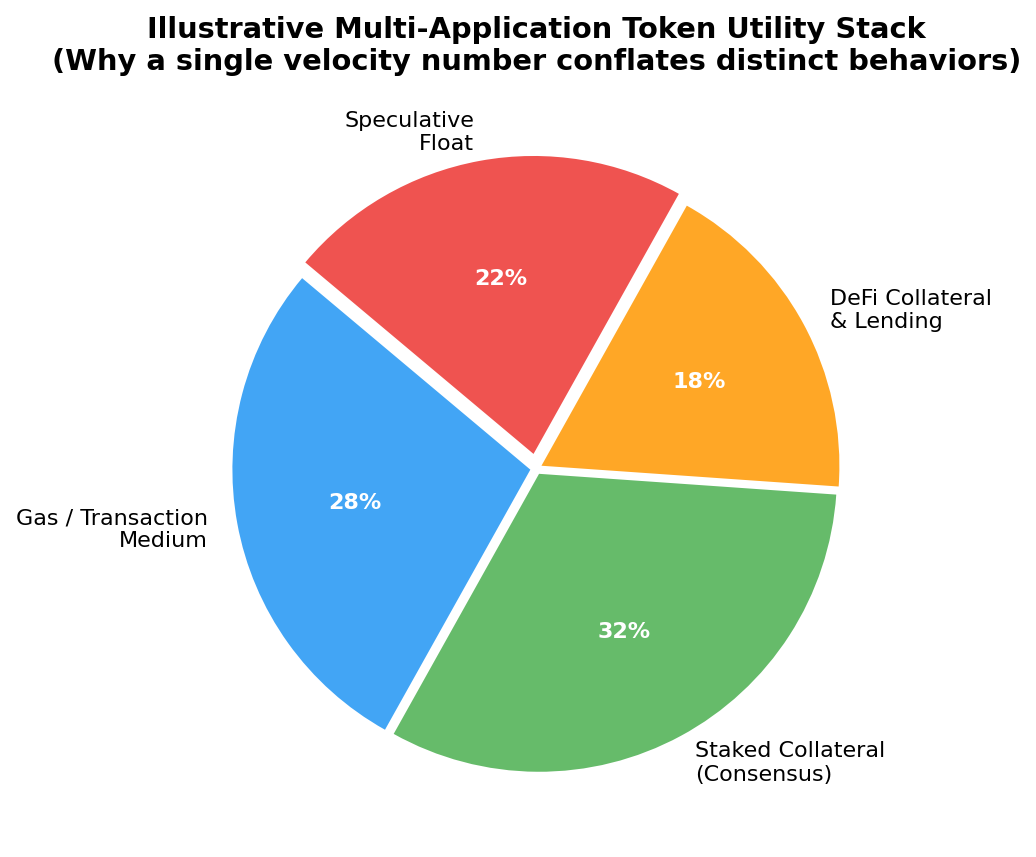
Under stress the problem becomes worse. Forced liquidations of leveraged, multi-application positions produce velocity spikes that are not neutral signals. They actively dismantle the very utility (unstaking validators, pulling collateral) that any functional model is trying to measure. Velocity therefore does not merely fail as a valuation input; during cascades it becomes an accelerant that degrades the functional base. Including it is self-undermining.
2. Structural Principle of This Framework
Consistent with the source thesis, velocity is excluded entirely as a valuation input. Everything below measures what the token is doing and what breaks without it, restated as auditable, on-chain quantities. Philosophy and narrative are likewise excluded as pricing inputs: they may motivate adoption but cannot price an asset. The framework operationalizes the two tests proposed in the thesis (the Necessity Test and the Cost/Competitive-Substitution Model) into measurable layers, then adds practical refinements required for real evaluation of tokenized financial products.
3. The Core Layers
Layer 1 — Raw Functional Revenue (RFR), Net of Treasury Recirculation
Actual fees paid to use the network for its stated function: gas, transaction fees, protocol fees. Not trading volume or exchange turnover. RFR is the token equivalent of top-line revenue with no accrual distortion.
Refinement: report RFR net of protocol treasury flows that are immediately recycled into incentive programs. Gross fees that simply return to the same pool double-count activity.
RFRnet = Gross Functional Fees − Treasury-to-Incentive Recirculation
Layer 2 — Security Expenditure (SE), Real vs. Inflationary
The real, present cost of keeping the network alive: staking rewards, validator costs, absorbed slashing risk. Closer to a true operating cost than depreciation ever was.
Refinement: separate real security spend (funded by actual fee capture) from inflationary emissions. Inflationary SE dilutes holders and is not equivalent economic cost.
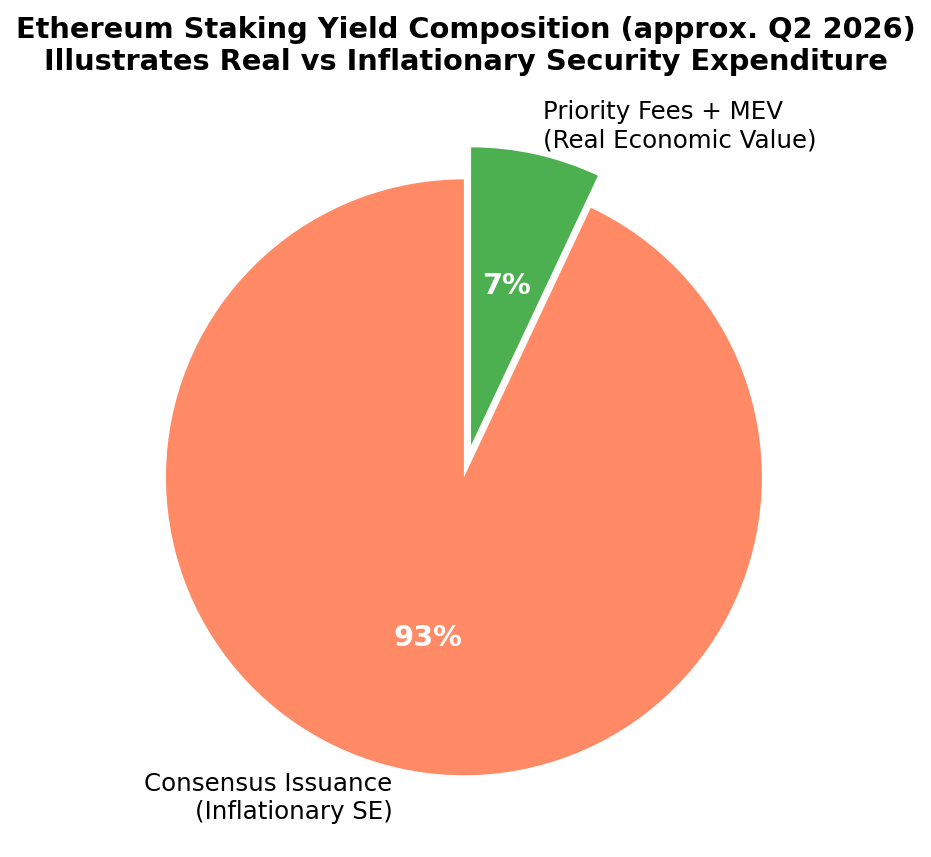
SEadjusted = SEreal + λ · SEinflationary
where λ ∈ [0, 1] is a dilution discount (default range 0.3–0.6). Pure-emission security is heavily discounted.
Layer 3 — Locked Utility Index (LUI) & Criticality Multiplier
Numeric expression of the Necessity Test. Collateral locked, total value dependent on continued function, and a criticality score for how much downstream infrastructure fails if the token disappears.
Scoring method: continuous dependency-graph metric rather than a discrete 1–5 tier. Weight total dependent value (TVL + notional + settlement volume), number and size of downstream protocols that would halt, recovery cost via nearest substitute, and optionally a systemic VaR-style impact measure. Normalize to a multiplier typically in the range 0.2–1.8. Load-bearing settlement assets sit near or above 1.0; decorative or pure-narrative tokens compress toward the floor.
4. Additional Practical Metrics
4.1 Adoption Elasticity (AE)
Sensitivity of functional usage to changes in effective fee rate. High (negative) elasticity signals fragility; low elasticity signals lock-in and pricing power. Converted to a bounded factor (approximately 0.7–1.3) that scales the composite.
AE = (% Δ Functional Usage) / (% Δ Effective Fee Rate)
4.2 Regulatory Risk Adjustment (RRA)
Forward-looking haircut for compliance, licensing, and jurisdictional exposure. Constructed from observable proxies: regulated-market admissions, licenses held, enforcement history, and compliance spend relative to RFR. Expressed as a fractional haircut so regulatory reality is not treated as free.
5. Stress-Adjusted Locked Utility: The Feedback Penalty
The source thesis shows that under stress, velocity spikes are not neutral; they actively dismantle functional utility through forced unstaking and collateral withdrawal. A static Criticality or LUI score measured in calm conditions therefore overstates the durable necessity of the asset. Any serious functional model must apply a stress adjustment that penalizes the Locked Utility Index for the observed or estimated fraction of locked value that is itself levered or rehypothecated and therefore vulnerable to cascade unwinding.
Define a simple Stress-Adjusted LUI:
LUIstress = LUIcalm × (1 − φ · Levered Locked Fraction)
where φ ∈ [0, 1] reflects the severity of historical or model cascade transmission (higher for assets with deep recursive DeFi leverage).
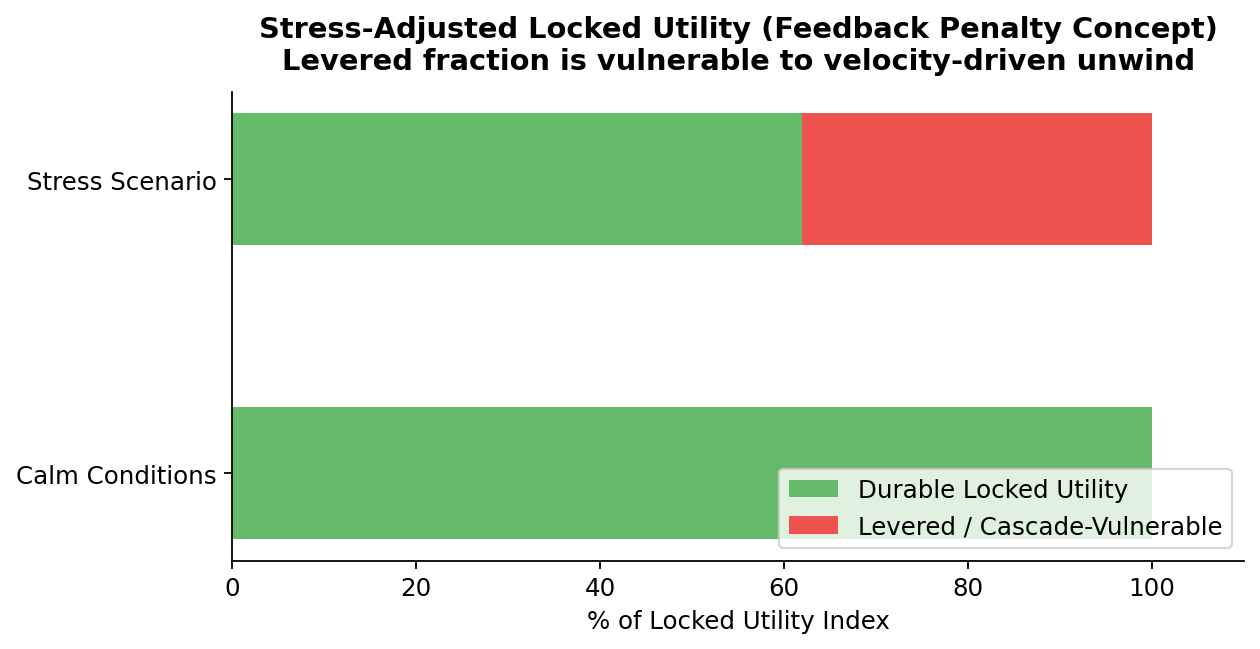
This prevents the framework from treating temporarily locked, highly levered utility as permanent load-bearing infrastructure. It directly incorporates the thesis’s warning that velocity under stress becomes an active destroyer of the very function being valued. In practice, on-chain data already allows estimation of the levered locked fraction in near real time for major assets.
6. Composite: Necessity-Adjusted Functional Output (NAFO)
Updated working formula:
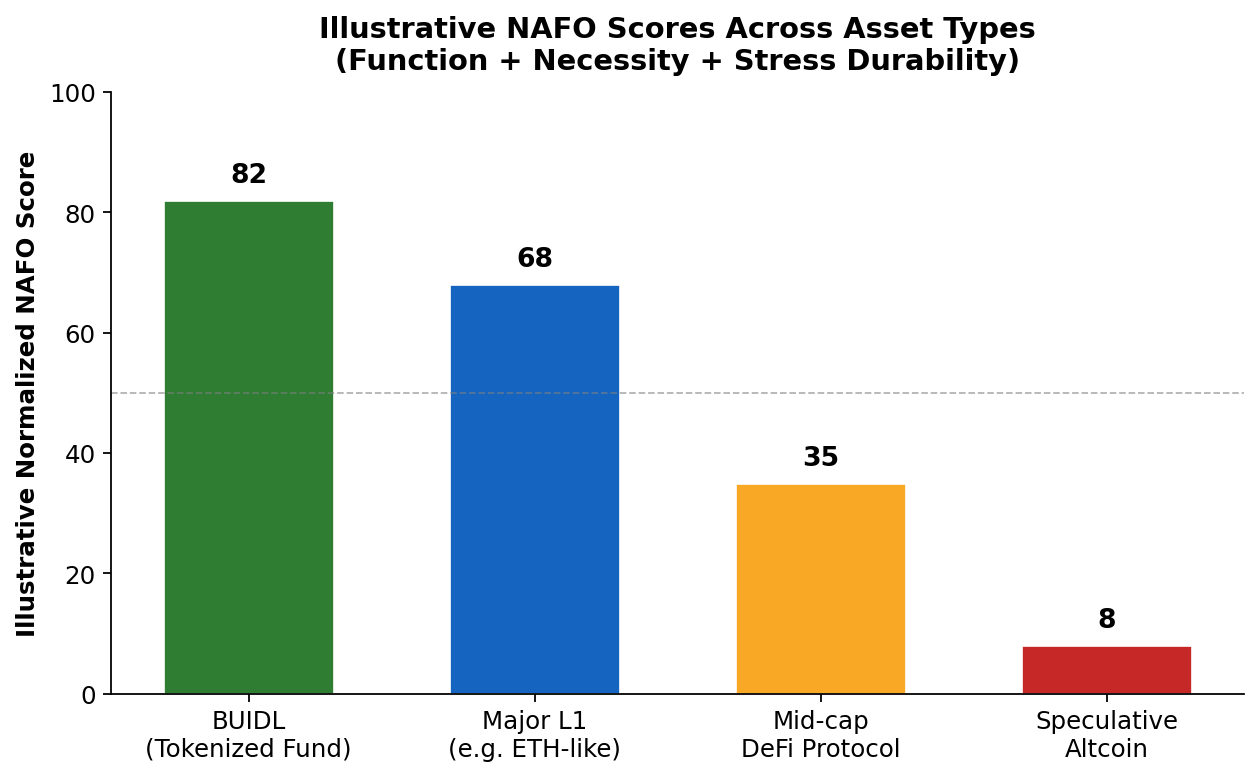
NAFO = [(RFRnet + SEadjusted − Substitution Cost) × Criticalitystress × AEfactor] × (1 − RRA)
Criticalitystress is the dependency-graph score after the LUI stress adjustment above. Substitution Cost remains the estimated cost of replicating the function via the next-best alternative. The whole expression is deliberately the inverse of EBITDA logic: nothing is added back; substitution cost is subtracted, security quality is discounted, necessity is stress-tested, demand stickiness is rewarded, and regulatory exposure is haircut. In a competitive multi-chain environment a function is only worth what it costs to displace, what survives forced unwinding, what users still pay under higher fees, and what regulators will permit to persist.
7. Worked Contrast: BUIDL vs. Speculative Altcoin
BlackRock’s BUIDL (tokenized fund)
RFRnet: high, stable, real administration and distribution fees; minimal recirculation into speculative incentives.
SEadjusted: negligible and almost entirely real (inherits Ethereum security).
Criticalitystress: high and relatively robust institutional rails, with low recursive leverage on the token itself.
AE: low elasticity expected once institutional users are onboarded.
RRA: low haircut, with a clear regulatory and compliance pathway.
Result: durable NAFO dominated by function and necessity, largely insulated from velocity or narrative.
| Metric | Approximate Value (mid-2026) |
|---|---|
| Total Asset Value / AUM | $2.68 billion |
| Management Fee Range | 0.20%–0.50% |
| Annualized Fees (DefiLlama) | $94 million |
| Annualized Protocol Revenue | $5.3 million |
| Holders | 115 |
| Underlying | U.S. Treasury / cash-equivalent assets |
Speculative altcoin with no protocol revenue
RFRnet: near zero.
SEadjusted: high on paper but almost pure inflationary emissions, therefore heavily discounted.
Criticalitystress: near zero; any locked value is typically highly levered and cascade-prone.
AE: high negative elasticity if any usage exists.
RRA: high haircut — usually unregistered.
Result: NAFO collapses toward zero, correctly identifying pure sentiment premium.
| Component | BUIDL (Tokenized Fund) | Major L1 (ETH-like) | Speculative Altcoin |
|---|---|---|---|
| RFRnet (real fees) | High & stable | Moderate, declining post-L2 | Near zero |
| SEadjusted | Negligible / inherited | Mostly inflationary (90%+) | Purely inflationary |
| Criticality (stress-adjusted) | High, low leverage | High but levered DeFi exposure | Near zero |
| AE / RRA | Low elasticity, low RRA | Medium | High elasticity, high RRA |
| Illustrative NAFO | High | Medium-High | Collapse toward zero |
8. Summary Comparison
| Dimension | Velocity-based (status quo) | This Functional Framework |
|---|---|---|
| Value derived from | Rate of circulation (MV = PQ) | Necessity + competitive substitution + stress-adjusted utility |
| Handles multi-use tokens? | Poorly — conflates distinct behaviours | Yes — each application assessed by its own function |
| Role of velocity | Foundational input | Diagnostic / forecasting only; stress penalty when it destroys utility |
| Behaviour under stress | Treated as valid signal even in liquidation cascades | Recognized as accelerant; LUI is stress-adjusted downward |
| Philosophy / narrative | Often implicit driver of “story premium” | Explicitly excluded as valuation input |
| Practical outputs | Mostly theoretical or velocity multiples | RFRnet, SEadj, Criticalitystress, AE, RRA → single NAFO score |
The core argument, restated: a token is worth what it does, how necessary that function is, how durable that necessity remains under stress, and what it costs to replace. Not how fast it moves. Under stress, how fast it moves can actively destroy what it is worth. This framework turns that claim into a concrete, auditable operating statement.
Sources for illustrative figures: public DefiLlama fee dashboards, RWA.xyz, BlackRock filings, Dune / research reports on Ethereum staking composition (Bitwise, The DeFi Report, ultrasound.money style trackers), and on-chain staking ratio observations (32–34% of ETH supply staked in 2026). All charts are conceptual or directional illustrations intended to make the framework’s distinctions concrete; they are not investment advice or precise valuations.