The Cash Leg · Essay 10 of 11 · Vendors · 23 September 2026
The Wiring
The instruction no core can obey
Pontes is two days old this week. The product that will have to live with it was designed not to replace the book downstairs.
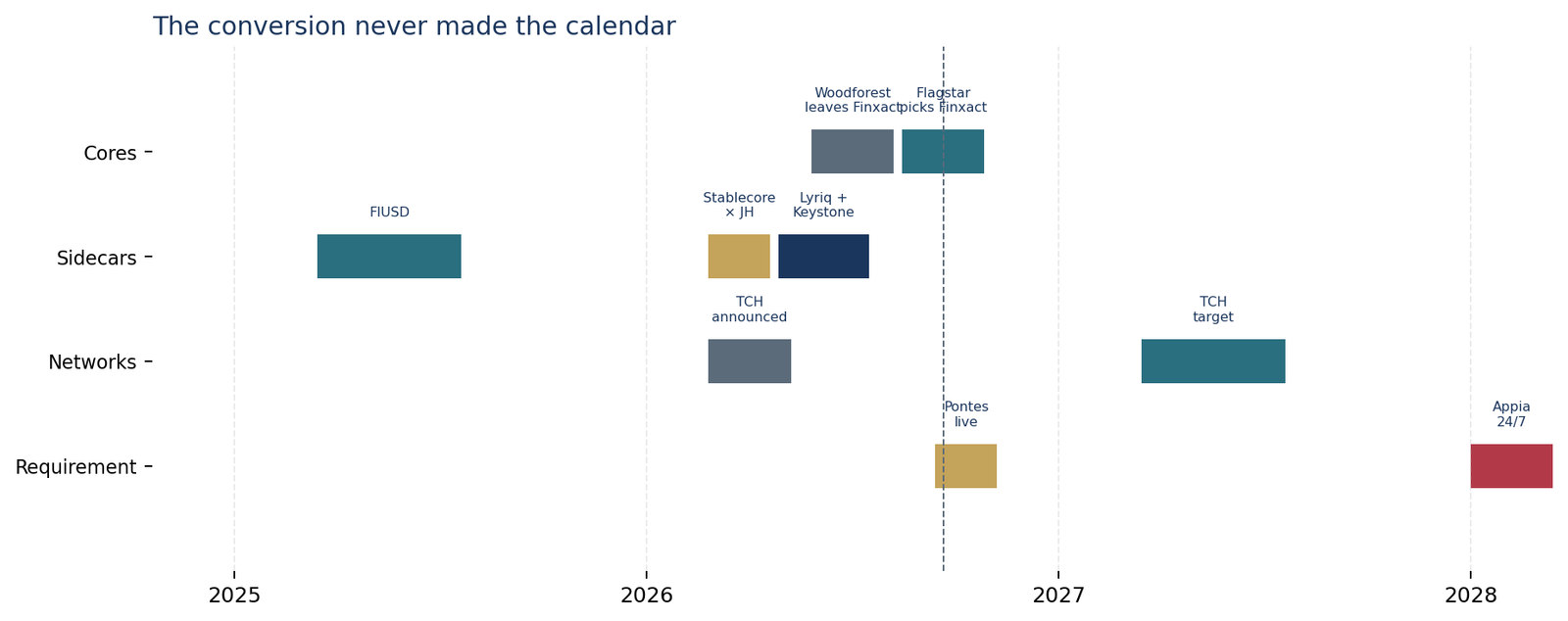
Two days after Pontes went live in Frankfurt, the cash leg is a production service on one continent and a product slide on another. On 29 April 2026 FIS launched Lyriq: banks issue, manage and settle tokenised deposits and digital currencies, keep them on the issuing bank’s own balance sheet, wire the object to whatever core is already there, settle around the clock, complete or fail cleanly. Seven proof-of-concepts. The next day, Project Keystone which is a bank-owned network on that sidecar, Citizens, Fifth Third, Huntington, KeyBank and M&T named, a sixth unnamed, national and regional and trust charters on purpose. Jim Johnson’s line was that a network that does not work for all of them does not work.1
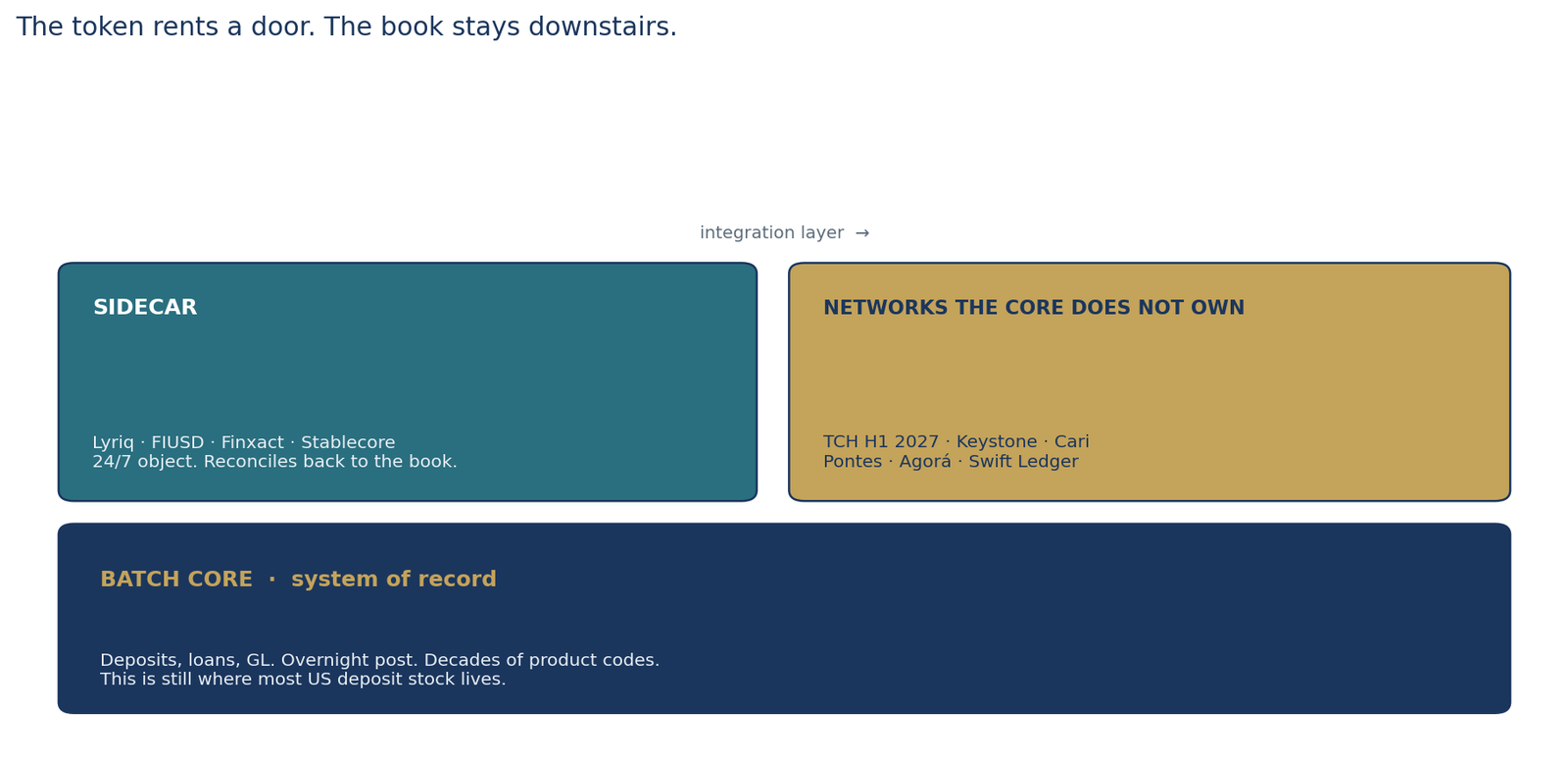
Read the sentence FIS needed to print. Integrates with existing core banking systems, regardless of technology provider. That is not a differentiator. It is the industry telling on itself. The core (deposits, loans, the general ledger) stays. The token lives next door. This essay is the cost of that admission, who it protects, and why, across every house examined here, 2026’s answer was a sidecar rather than a new book.
Essays one through nine were architectures. This is who has to wire them into machines designed before any of those architectures had a name, and who will be invoiced when the wiring does not hold. The invoice is the part of tokenisation that never appears in a central-bank speech and always appears in a core-banking renewal.
What a core actually is
Be unromantic. A core is the system of record. In most American community and mid-tier shops, and in a meaningful share of larger ones, it still posts overnight. Cards, ACH, wires and now tokens all come home to that batch. Atomic settlement in eighty seconds assumes a ledger that can answer in eighty seconds. Pontes assumes a participant that can work 09:00 to 16:00 today and, on the 2028 slide, around the clock. A batch core answers tomorrow morning. Nothing about token speed matters if the receiving institution can only book the receipt once a day. The cash leg can be live in Frankfurt at nine o’clock and still be a pending item in Missouri at nine o’clock the next morning. That is not a metaphor. It is a posting calendar.
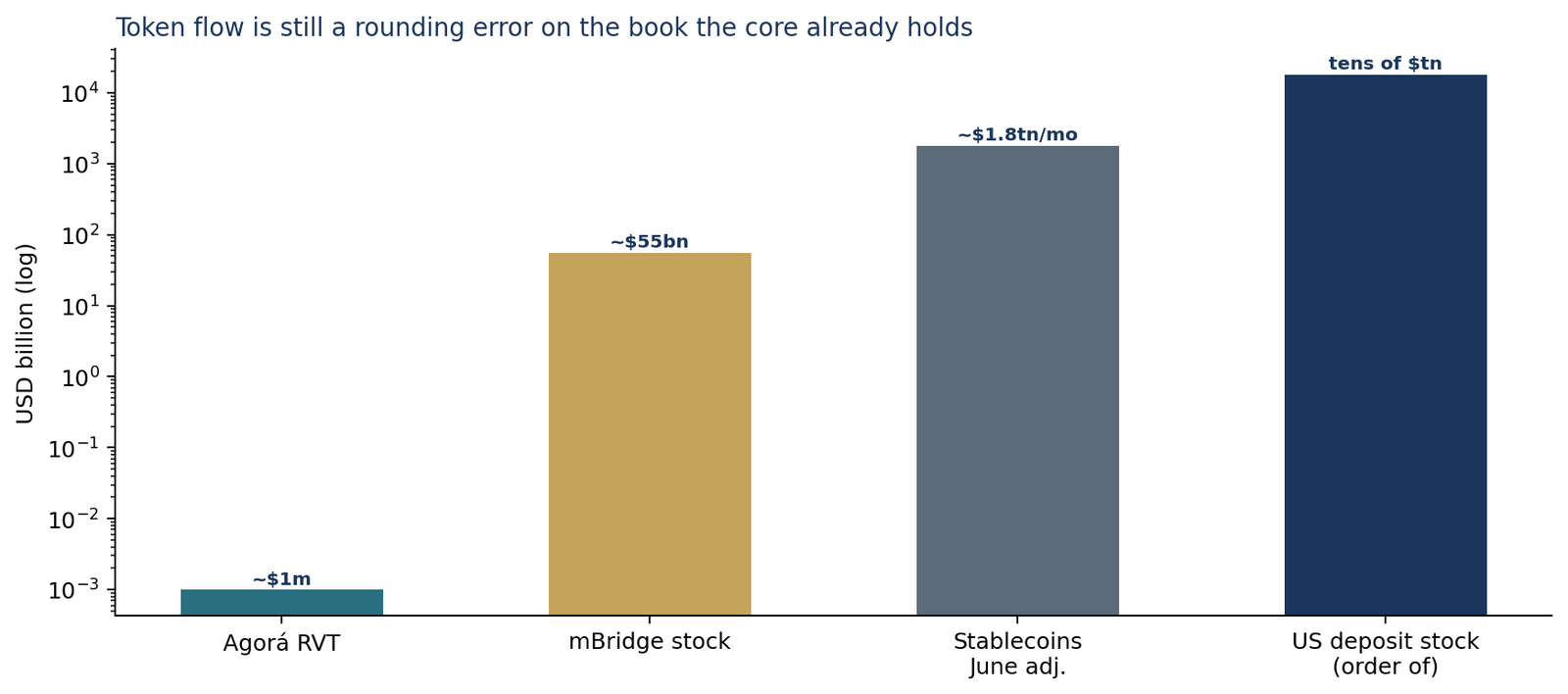
That mismatch is close to structural. A mid-sized conversion is not a weekend window. It is eighteen months to several years of parallel books, rebuilt product codes, fee schedules, interest logic, examiner hooks, staff who have to unlearn the old screens, and a cutover that has, in this industry’s memory, gone wrong in public. Asking a client to absorb that risk so the bank can be “token-ready” is asking it to bet years of operational risk against a token book that is still, industry-wide, a rounding error on the deposit stock already sitting downstairs. Against that asymmetry the sidecar is not timidity. It is the only rational product a vendor can sell to a base measured in thousands of institutions and trillions of dollars of deposits.10
The installed base, honestly sized
Resist two temptations: understating how much of the US book still sits on a handful of these firms, and inflating that into a global percentage. The honest version is a table.
| House | Where the book still sits | What it launched at the token | The tell |
|---|---|---|---|
| Fiserv | US core + digital; ~$2.4bn banking revenue; 3,500+ FIs; $1 of core → ~$2.70 of other Financial Solutions | FIUSD (2025); Finxact; Roughrider Coin; Mastercard path | Flagstar picks Finxact in August. Woodforest leaves it in May. |
| FIS | Banking + Issuer Solutions after Worldpay sell-down. Q1 Banking ~$2.37bn. Five de novos in H1 including Mercury; $100bn+ merger core | Lyriq + Keystone. Circle USDC path. Digital-euro / CBDC hooks discussed | “Regardless of provider” is the strategy. |
| Jack Henry | Community banks and CUs. Woodforest: largest new-core signing by accounts | Stablecore on the Fintech Integration Network, ~1,670 cores; USDC beta on the public-cloud platform | Quietest headline. Growing base. Not Pontes hours. |
| Temenos | ~3,000 FIs globally; HSBC / StanChart-class multi-country | Taurus into securities processing | Closest incumbent to Agorá-bank workflows. |
| Thought Machine / Mambu | Greenfield, digital banks; client counts in the low hundreds at most | Native programmable / SaaS ledgers. Islamic module at Mambu. No public mBridge adapter | Win logos. Have not moved a forty-year deposit book. |
Table 1. Installed base is the argument. Token products are the footnote — except when a client walks off Finxact.
Fiserv still describes itself as first in US core and digital. FIUSD was built to sit on existing Fiserv frameworks without a rip-out. Finxact is the cloud-native ledger the company points at when the conversation turns to tokens. On 17 August Flagstar named Finxact as the system of record under its S2 programme and said temporal processing would kill end-of-day batch on that platform. Three months earlier Woodforest ($9 billion of assets, more than 740 branches across seventeen states, an early Finxact adopter in 2020) signed Jack Henry in the largest new-core deal of that vendor’s life by account count, and the trade press said the book was coming off Finxact. One win and one exit on the same product in the same year is the honest Finxact paragraph. Neither print, alone, is a verdict.34
FIS is not the Worldpay company. Banking Solutions and Issuer Solutions are the 2026 story. Five new charters in the first half, Mercury among them, an unnamed $100 billion-plus merger core, two top-fifteen proofs that a bank can bolt modern components onto the old environment and leave the core in place. Lyriq is the sidecar. Keystone is the club on the sidecar. Circle is the other door, for banks that want a GENIUS coin rather than their own deposit token. Two doors, one vendor, no claim that the basement changes.5
Jack Henry did not ship a Lyriq. In February Stablecore joined the Fintech Integration Network so roughly 1,670 core clients, and the Banno digital base, can switch on stablecoin rails, tokenised deposits and on-ramps without moving the ledger. The firm has also said it is beta-testing USDC payments on its public-cloud platform. That is sidecar by another name: a partner in the network, not a new mint. Woodforest is evidence the community-and-lower-end-of-regional book is still for sale. It is not evidence that book can keep Pontes hours.4
Temenos took the securities door. Taurus puts token creation, wallets and settlement inside workflows the bank already uses for conventional paper. For an internationally active house that already sits in Agorá’s private cohort, that is a more natural fit than a US community-bank core growing a stablecoin SKU. Thought Machine’s Vault remains the closest thing in this list to a native programmable deposit ledger. Mambu remains the SaaS win for neobanks, with Swift connectivity and an Islamic module that matters for essay five. Neither has published an Agorá or mBridge adapter. Neither has taken a tier-one deposit history off a forty-year book. Greenfield is not conversion. Conversion is the contest, and it is almost unrun.6
Three postures, not two camps
Incumbent versus challenger is the wrong binary. There are three postures, and a bank can sit in two of them at once without admitting it.
Sidecar incumbents keep the batch book and sell a 24/7 object beside it. Reconciliation is the SKU. It is the only posture that does not ask thousands of clients to convert on tokenisation’s calendar, and therefore the only posture the installed base will fund in this decade.
Greenfield cores build continuous settlement in from the first line. They win charters and digital brands because those shops have no basement. They do not yet hold the stock. Flagstar’s Finxact selection is the closest an incumbent cloud ledger has come, in public, to claiming the basement itself will stop batching. Woodforest’s exit from that same basement six years after moving in is the reminder that “real-time core” is still a conversion, with conversion politics, even when the vendor already owns the client. Two data points. One product. The industry is not of one mind about whether Finxact is the sidecar or the new book.
Bank clubs skip the vendor question. The Clearing House, on 5 June, put a bank-led on-chain deposit initiative in public with a connectivity layer back to RTP and CHIPS. The target date that has stuck in the coverage is the first half of 2027. JPMorgan, Bank of America, Citi, Wells and peers are the gravitational field. Keystone is the super-regional version of the same instinct, on FIS metal. Cari is a third regional cohort on another stack. If the network becomes the cash leg, the core vendor is a customer of the club. That is a smaller job than “system of record.”2
The tell inside the clubs is the double booking. Huntington, KeyBank and M&T show up in Keystone and in Cari. Citizens and Fifth Third show up in Keystone and in the TCH conversation. Banks are hedging networks the way vendors ship sidecars. Nobody wants to guess which rail clears when a Keystone token has to meet a Cari token. That join is not in any release note. It is the same vacancy essay nine named at the Fund, now sitting in a product committee in Ohio.7
The series, forced onto the roadmap
Each prior essay is now a requirement on whichever core serves a bank inside that jurisdiction. None of them were written as a vendor specification. All of them arrive as one.
| Essay | What the core is asked to do | What actually ships |
|---|---|---|
| 01 UK | Trigger back to RT2, not a shared mint | A connector, if the client pays for London |
| 02 Switzerland | Dual rail: SDX token and SIC | National stack, not a catalogue item |
| 03 / 09 Pontes | Cash token or T2 trigger; 09:00-16:00 now; 24/7 in 2028 | A project. Not a checkbox. |
| 04 Korea | Two-tier plus fiscal programmability | Hangang-side work, not a US SKU |
| 05 GCC / Islamic | Asset-backed contracts; AAOIFI 62 still draft | Mambu has a module. That is not a fatwa. |
| 06 China | Refuse the wrapper onshore; HK as valve | A do-not-build list |
| 07 US | GENIUS coin and deposit token; no Fed retail token | FIUSD, Lyriq, Stablecore, TCH - four answers |
| 08 Agorá | Unifying deposits, jurisdictional reserves; USD as bank token | A test seat, not a product |
| 09 IMF | Same activity, same risk, across all of the above | No SKU exists |
Table 2. Nine architectures. Zero cores that ship the matrix. “Both clubs” is not a part number.
Take one concrete shop: a large international bank with a London desk, a Frankfurt euro subsidiary, dollar clearing, and a Hong Kong correspondent. That one treasury needs, at once, a synchronisation trigger to RT2, a Pontes cash-token or T2-trigger choice inside office hours, a GENIUS coin and a separate deposit token for the dollar, an Agorá-shaped interface if the desk is invited back into a real-value run, and an internal ban on ever letting any of that touch an mBridge-connected system. No vendor here sells that as one pre-integrated product. Every vendor sells pieces. The bank’s own compliance team does the join and the refusal.
That shop is also why Temenos’s Taurus path and FIS’s “regardless of provider” sentence can both be true and still leave the bank unhappy. Temenos embeds the token in securities processing the desk already runs. FIS embeds the token beside whatever core the bank already owns, including a Temenos core. The bank then owns two integrations, two vendors, two audit stories, and one examiner who will ask which book is the book when a Pontes ticket and a Keystone ticket hit on the same afternoon. Sidecars multiply. They do not compose. Composition was supposed to be the point of a unified ledger. The vendor market of 2026 is the proof that unification happened in white papers and multiplication happened in contracts.
Who is actually losing, with magnitude
The losing object is not a ticker. It is an assumption. Overnight batch as the only system of record loses the moment 24/7 settlement stops being a slide and becomes a supervisory expectation. Several central banks in this series have published timelines that point that way. The high-margin payments attach that assumed the core owned the movement of money (correspondent tolls, card windows, ACH batches) is exactly what TCH 2027 and Swift’s ledger are built to intercept. Community cores that cannot fund a sidecar and a conversion at once are in a squeeze. Jack Henry’s Woodforest win says the base is still growing. It does not say the base can run Frankfurt’s hours.
Challengers lose a different game if they confuse a digital-bank logo with a converted book. A Vault win is a real client. It is not four thousand US conversions.
None of this is a market-share collapse, and the essay should not let the detail impersonate one. Fiserv’s $1-to-$2.70 attach and FIS’s recurring mix inside Banking Solutions are how an incumbent rents the door for years. What they are renting is a smaller annuity than sole ownership of where the money lives. Industry shorthand still puts Fiserv, FIS and Jack Henry under a large majority of US chartered institutions. Use that as the size of the basement. Do not use it as a global fraction, and do not use website-scrape “banking category” shares that put a payments company in first place.9
Stablecoin adjusted volume of about $1.8 trillion in June looks enormous next to Agorá’s million dollars. It looks small next to the deposit stock the cores already book. That comparison is why the sidecar is rational and why it is also a ceiling. The vendor makes money on the door. The club on the other side of the door (TCH, Keystone, Cari, Pontes, Agorá) is trying to own the hallway.
Be precise about what has not been disclosed. Neither FIS nor Fiserv has printed a token-revenue line that a reader can put next to the $2.4 billion banking annuity. Lyriq is “limited availability.” FIUSD is a product with named partners and no public national volume. Keystone is a founding cohort, not a cleared book. Treating those launches as a replacement P&L is how a vendor essay turns into a stock story. This is not a stock story. The magnitude that is real is the attach: core is the door into ten other products. If the hallway moves to a bank club, the attach is what thins, not the deposit ledger on day one.
Correspondent banking is the quiet P&L at risk. A core vendor that sat in the middle of nostro movement collected a toll that looked like software. TCH wants tokenised deposits to clear among members and still touch RTP and CHIPS. Swift wants the orchestration layer and the old rails at the end of the ticket. Pontes wants the cash leg in TARGET. Agorá wants a unifying ledger that does not belong to Fiserv. Each of those sentences is a bid to take movement away from the vendor without taking the deposit account. Movement was where the margin lived. The account is where the switching cost lives. 2026 is the year the industry started trying to separate the two.
That separation is also why community banks feel the squeeze first. They do not sit on TCH’s founding list. They do not staff a Keystone and a Cari committee at once. They buy what Jack Henry or Fiserv packages. If the package is a partner integration and a beta USDC rail, they get a door. They do not get a seat in the hallway. Supervisory expectations of 24/7 settlement, if they arrive on the Appia or EnsembleTX timetable, will land on those shops as a vendor invoice, not as a club vote.
The unbuildable SKU
One cell in the matrix is not an integration. It is a wall. A vendor that serves American and European banks cannot ship an mBridge adapter as a catalogue twin to its Agorá connector. Notice 42 makes the unapproved onshore wrapper illegal. Hong Kong is the valve, not a loophole for a global SKU. The honest product is two stacks, two compliance teams, and a written “do not connect” list. Essay nine’s referee without a pitch becomes, here, a red line on a roadmap signed by a lawyer in Jacksonville rather than a governor in Basel.8
The same wall exists in miniature inside the United States. Keystone does not clear Cari. TCH has not said it will clear either. Swift Ledger still finishes on old rails. Four Western deposit-token stories in one year, and the join between them is the unbuilt object. Vendors will not build it for free. Banks that sat down in two clubs already know that. The Fund cannot order it. The last essay has to draw the map those refusals make.
Close
The wiring houses will implement what they are paid to implement. They will not reconcile two geopolitical clubs in a release note, and they will not reconcile three American deposit-token networks in one either. That was never a fair job description for a core vendor. The sidecar is not a failure of imagination at Fiserv, FIS, Jack Henry or Temenos. It is the correct response to nine architectures that were never designed, by the sovereigns that built them, to be one product. Correct is not the same as sufficient. Sufficient would be a book that can answer the cash leg in the cash leg’s own window. That book is still, for the stock of deposits that matter, tomorrow morning’s batch.
The conversion that would make the sidecar unnecessary never made the calendar this decade. The map of what that leaves (two clubs, three assets, four American networks, and a basement that still posts overnight) is the last essay in the series.
A fair last word on the challengers, because the original mood music of this chapter (written before the series existed) treated them as the inheritors. Architecturally they still look like inheritors. Vault can express a programmable deposit without an overnight batch. Mambu can stand up a book in a new charter and already carries an Islamic module that essay five’s shops would recognise as at least a conversation starter. What they have not inherited is time. Time is what the incumbents bought with the sidecar: years in which the deposit stock stays downstairs while the token experiments upstairs. If TCH, Pontes and Agorá remain club projects for the rest of the decade, that purchase was cheap. If 24/7 central-bank settlement becomes a licence condition, the purchase comes due and the challenger ledger looks less like a niche and more like the only book that can answer in the same window as the cash leg. September 2026 is too early to call that condition. It is not too early to see that every incumbent roadmap is a bet it never arrives.
Japan and India, which the last essay will only be allowed to mention, are the reminder that this vendor map is still Atlantic. Finacle and BaNCS hold books this piece has not sized. A yen-denominated government-bond token settled in wholesale CBDC, if Tokyo goes live on the timetable its ministries have discussed, will not care whether Lyriq integrated with Premier. An India stack built around a public retail rail and a private UPI habit is not a sidecar problem; it is a different basement. The wiring houses in this essay are the wiring houses of the two clubs already named. They are not the wiring houses of the whole map. That limit belongs in the body so essay eleven does not have to rescue it.
Sources and notes
1. FIS, FIS Launches New Platform Giving Banks Control Over Digital Money, 29 April 2026 (Lyriq: tokenised deposits and digital currencies on the issuing bank’s balance sheet; works with existing cores regardless of provider; seven PoCs; 24/7 atomic post). FIS, FIS and Leading Financial Institutions to Build Their Own Digital Tokenized Money Network, 30 April 2026 (Project Keystone; Citizens, Fifth Third, Huntington, KeyBank, M&T named; six banks total).
2. The Clearing House, Major Financial Institutions Unveil Bank-Led On-Chain Money Initiative, 5 June 2026. On-chain clearing of tokenised deposits; connectivity to RTP and CHIPS; target often reported as first half 2027. Citi, JPM, BofA, Wells and others in the public coalition. Citizens and Fifth Third appear in TCH commentary and in Keystone.
3. Fiserv 2026 investor language: banking ~$2.4 billion revenue, 3,500+ FIs, $1 of core pulling about $2.70 of other Financial Solutions; company claim of US leadership in core and digital. FIUSD (2025) on Paxos/Circle via Solana; Finxact as cloud-native ledger; Bank of North Dakota Roughrider Coin; Mastercard path. Flagstar selects Finxact, 17 August 2026.
4. Jack Henry, Woodforest National Bank Selects Jack Henry, 28 May 2026: >$9 billion assets, 740+ branches, largest new-core signing by account count. FinTech Futures, 1 June 2026: migration off Finxact, adopted 2020. Stablecore joins Jack Henry FIN, 23 February 2026: ~1,670 core clients plus Banno institutions; GENIUS-compliant stablecoin rails without a core swap. JH also beta-testing USDC payments on its public-cloud platform.
5. FIS H1 2026 core wins: five de novo banks including Mercury (conditional national charter / FDIC insurance path); unnamed newly formed institution >$100 billion assets; two top-15 proofs of value for component modernisation. Banking Solutions Q1 2026 about $2.37 billion GAAP. Worldpay sold down earlier; 2026 story is Banking + Issuer Solutions.
6. Temenos–Taurus partnership for tokenised-asset creation, wallets and settlement inside securities processing (industry coverage May 2026). Thought Machine Vault Core and Mambu SaaS: greenfield and digital-bank wins; client counts in the low hundreds at most; no public Agorá/mBridge adapter.
7. Cari Network reporting 2026: regional cohort including Huntington, First Horizon, M&T, KeyBank, Old National, SouthState on a separate stack. KeyBank, M&T and Huntington publicly associated with both Cari and Keystone. That double-booking is the banks hedging the same way vendors ship sidecars.
8. Carry-forward: Pontes live 21 September 2026, 09:00–16:00 euro (essays 03, 09). Agorá RVT ~CHF 800,000 / ~80 seconds, five testing CBs (essay 08). mBridge ~$55.5 billion, ~95% e-CNY (essay 06). Visa-adjusted stablecoin volume $1.79 trillion in June 2026 (essay 09). Notice 42 (essay 06). GENIUS / no Fed retail token into 2030 (essay 07).
9. Swift Ledger, 9 July 2026, 17-bank pilot; Citi live tickets with FAB and OCBC in September (essay 08). Industry estimates that Fiserv, FIS and Jack Henry still sit under a large majority of US chartered institutions - use as order of magnitude for the US book, not as a global share.
10. Conversion reality: multi-year parallel runs, configuration rebuild, examiner sign-off. Flagstar’s Finxact selection is marketed as eliminating end-of-day batch on that platform; Woodforest’s exit from the same product six years after adoption is the counter-print. Both belong in the same paragraph.