The Cash Leg · Essay 11 of 11 · 25 September 2026
The Map
Two clubs, three assets, one property money might lose
September 2026 did not pick a winner. It developed the photograph of a market that had already chosen sides without calling the choice by that name.
That is the thesis this last essay exists to state after ten pieces of evidence. What the month made visible is partition: two settlement clubs that do not overlap, three cash-leg assets that are all alive, a sidecar industry wiring both clubs without reconciling them, and no institution with the authority to force a join. This is not a new architecture. It is not a ninth club. It is the map the first ten essays leave when they are laid on one table. A map is not a verdict. It is the drawing that makes a verdict possible later, when someone finally has to say whether two euros, two dollars and two corridors are still the same money.
Open on this week
Pontes is live. It launched on 21 September with thirteen market participants onboarded at once (Deutsche Bank, Santander, Société Générale, DekaBank, DZ Bank, the European Investment Bank, KfW, ABANCA, BayernLB, Caisse des Dépôts, Cecabank, Memo Bank, NRW.BANK) and the Bundesbank itself as a market participant. Four DLT operators connected on day one: Clearstream, SWIAT, Cashlink, and Axiology. Axiology’s stack is built from permissioned code derived from the XRP Ledger. Pontes settlement does not touch public XRP, and this essay will not pretend otherwise. Euro only. 09:00 to 16:00. One-off fees as essay three wrote them: EUR 15,000 for an operator, EUR 2,500 for a participant, no running tariff in the opening phase. Thirteen names on a production day is a coordination fact. It is not first volume. This essay has no confirmed ticket book from the opening week and will not invent one.1
Keep the wall. Wholesale Pontes is not the retail digital euro. Lagarde’s own launch-week language kept it bank-to-bank: a digital euro so banks can settle tokenised assets among themselves. Citizens stay outside what switched on Monday. The retail track is still a bill in the co-legislators’ hands. A retail pilot is not on the 2026 calendar. Mixing the two tracks is how a production cash-leg gets sold as a wallet. This series will not do that on the last page.2
Do not write that the IMF was answered. Essay nine’s vacancy still holds. One bloc switching on its own rail makes that rail harder to walk back from. It does not bind Beijing, Washington or Riyadh. It does not narrow the fracture. A launch-week roundtable in Frankfurt and a staff Note in Washington can share a calendar and still share no pipe. That sharing-of-calendar without sharing-of-pipe is the month in one clause.
The map itself
| Cash-leg type | Who runs it | September 2026 | Will not talk to |
|---|---|---|---|
| Public wholesale token / trigger | Pontes, Helvetia, Hangang wholesale, BoE lab | Pontes production; others live or lab | mBridge |
| Club unified deposits | Agorá | ~$1m RVT; 5 of 8 CBs issued reserves | mBridge |
| Corridor multi-CBDC | mBridge | ~$55.5bn stock; ~95% e-CNY | Agorá / Pontes |
| Private wrapper | GENIUS / MiCA coins | ~$1.8tn adj. June volume | Onshore CNY activity |
| Bank deposit token | TCH, Keystone, Cari, Lyriq | Networks forming; TCH aimed H1 2027 | Each other, so far |
| Fiscal / retail public | Hangang, India e₹, UAE Digital Dirham | Domestic | Not a global rail |
Table 1. Read the right-hand column first. The fracture is the map.
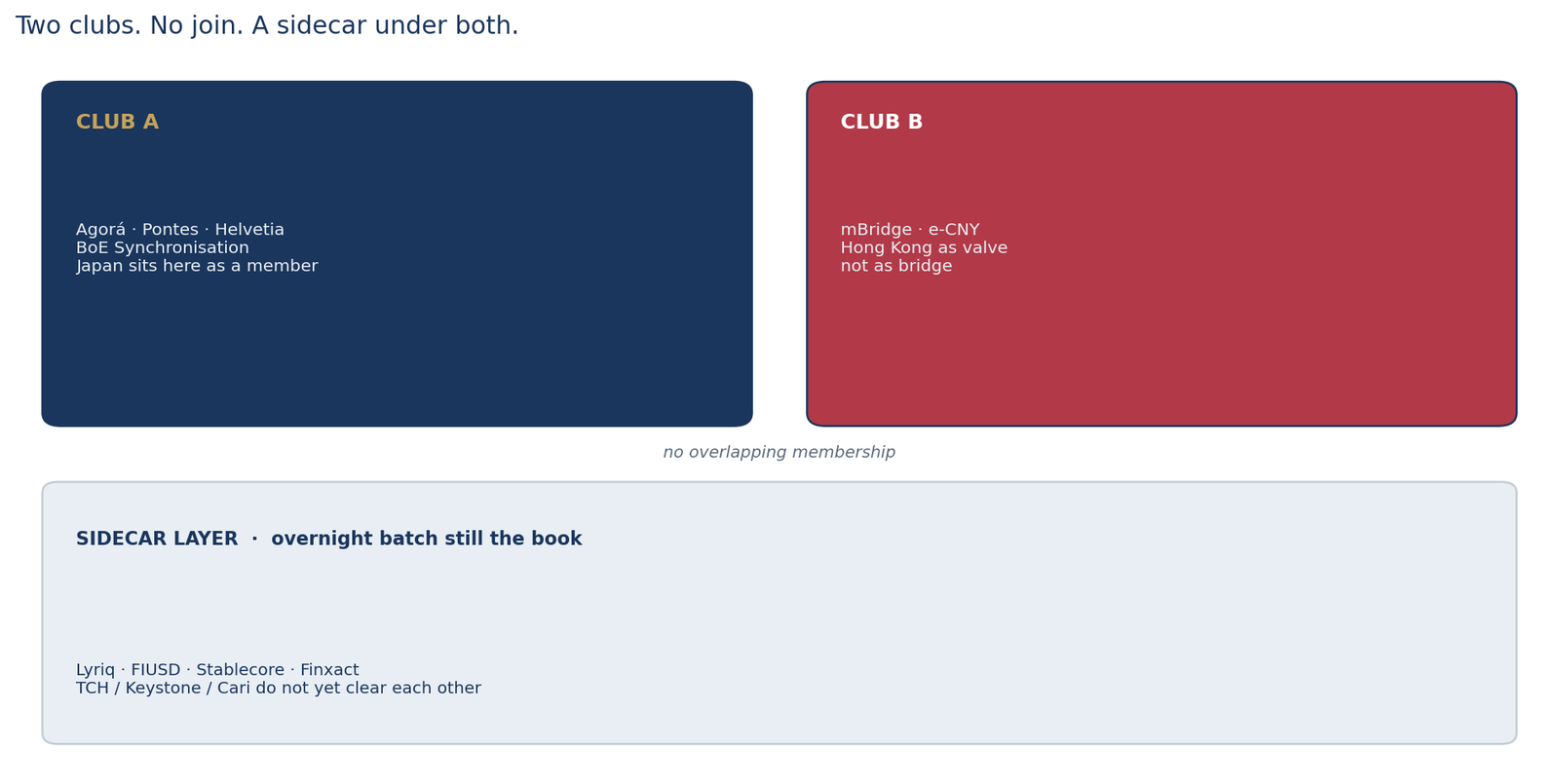
Walk the table. Club A is Agorá, Pontes, Helvetia, London’s lab. They disagree about who should run the connective tissue. They still sit in the same orbit; in July some of them sat in the same room. Club B is mBridge, the e-CNY, and Hong Kong as the sanctioned valve and not as a bridge. Almost no institutional join exists.
The right-hand column does work no single earlier essay could do alone. Every public wholesale project in this series names mBridge as the system it will not talk to. mBridge names Agorá and Pontes in reply. The wrapper row names onshore China because Notice 42 named it first. The deposit-token row is the sobering domestic print: TCH, Keystone and Cari cannot yet talk to each other either, inside one country, often with the same banks in two rooms, under one statute. Fragmentation does not require a rival bloc. It only requires that nobody has standing to insist on one rail. The Fund named that standing problem in April. The vendors inherited it in product form in April. The banks demonstrated it by sitting down twice. The map is those three facts drawn as one line.
Lay the Fund’s three-asset taxonomy across the same picture and a second axis appears. Deposit tokens, stablecoins and reserve tokens are all growing this month, inside both clubs and outside them. The Notes refused to rank them. This essay refuses too. Coexistence is the photograph. Partition is the risk if coexistence has no par.
Under both clubs sits essay ten’s layer. The sidecar wires the chosen cash leg onto a core that, for most of the deposit stock, still closes its books at night. Pontes launched this week. The posting calendar underneath most of the banks that connected did not.
A one-line recap of the ten answers, because the map is those answers in one frame. London built a trigger, not a mint. Switzerland built a vertical stack and ran it in production. Frankfurt decided to operate both doors itself and switched one on this week. Seoul wired public money to fiscal conditions and used that competence to sit in Agorá. The Gulf and Malaysia insisted the contract precede the pipe and are still waiting on a standard. Beijing closed every door but one and ran a corridor in its own currency. Washington licensed the wrapper and left the Fed off the July reserve list. Agorá built a shared marketplace that seven central banks joined and one corridor will not. The Fund wrote rules for a rail it does not run. The vendors rented a door onto a book they would not replace. None of those sentences is a criticism of the institution that wrote it. Together they are the partition.
The September that must be named
A dated list, because the density of the month is part of the argument: the picture moved fast while the fracture stayed put.
21 September - Pontes on.
April-June - Lyriq on the 29th, Keystone on the 30th; TCH’s bank-led network in public, aimed at the first half of 2027; Cari as a third American stack. Three US networks, one currency, no shared standard.6
July - Agorá’s real-value test. Swift Ledger’s seventeen-bank pilot. Citi live tickets on that ledger in September, first US bank to say so.
June - adjusted stablecoin volume $1.79 trillion. The private wrapper still outruns every public architecture in this series on raw flow.5
August - Japan’s FSA, Finance Ministry and Bank of Japan form a study group with the large banks for a stock-and-JGB chain, 24/7 as the ambition, a plan due early 2027, operations talked about for the early 2030s. MUFG’s Canton proof of concept for JGB repo as a test of timing on a market in the mid-hundreds of trillions of yen, not a live JGB book.4
11 September - two reports, two capitals, one question. The Bank of Japan’s pilot-program note: a mixed load of 10,000 update transactions and 40,000 balance inquiries a second on the experimental system, fifty thousand TPS in that specific mix, no technical knockout factor found for scaling toward a design assumption of five hundred thousand. That last number is a planning target, not a print. The issue decision remains “public discussion.” The same day in Mumbai, Sitharaman told the Global Fintech Fest that REC had completed India’s first tokenised corporate-bond pilot under SEBI’s sandbox, bond and digital rupee moving “at the exact same instant,” and then asked the sentence this series was built on: every tokenisation architecture returns to what the money leg is made of.34
Ongoing - EnsembleTX still aiming at 24/7 wholesale CBDC by the end of 2026; note the aim, do not upgrade it to a production confirmation. AAOIFI 62 still draft. Notice 42 still the wall.7
Special mention: Japan
Japan is not a third club. Resist the promotion. It is a late, large wholesale project arriving after every other architecture in this series had already chosen a shape.
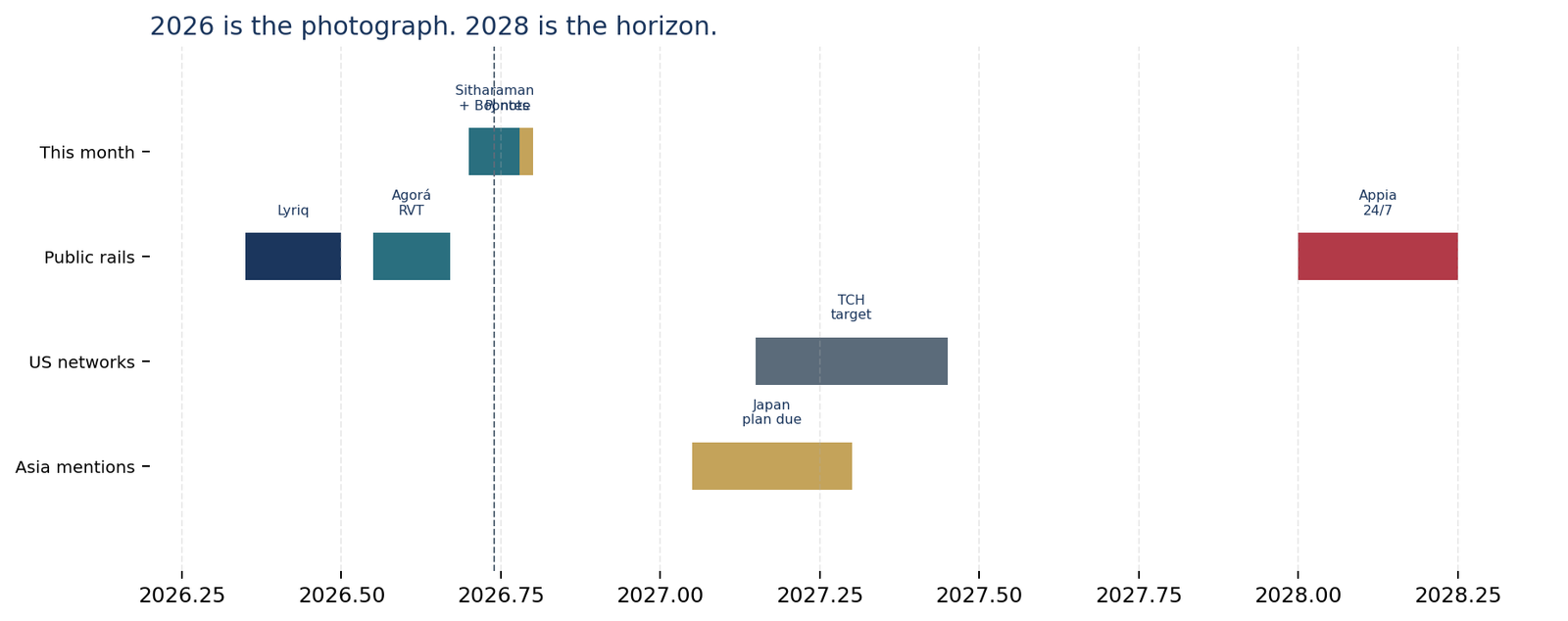
The scope is government bonds and listed stocks together, Bank of Japan reserve tokens as the intended anchor, a development plan due early 2027, operations not expected until the early 2030s which are further out than Frankfurt’s 2028 24/7 line. The private groundwork is running: MUFG on Canton for JGB repo, parallel work from Mizuho, Nomura, SMBC and JSCC, asking whether rights on a repo market of roughly ¥250–270 trillion can move from a one-to-three-day window toward something near instant without tearing up the book-entry statute. Japan is already inside Club A as an Agorá member, with London, the Eurosystem, the New York Fed, Seoul, Mexico City, Bern and Ottawa.
Retail is another track. The 11 September note showed a pilot that can take a mixed fifty-thousand-TPS load and found no fatal barrier to thinking about social-implementation volumes. It offered no launch date. Technical readiness and institutional resolve are not the same variable. This series has now watched that gap in almost every capital it visited.
The risk Tokyo has not had to answer in public: a superb national wholesale rail, years in the making, that still has to choose a club or become a well-built third island after Pontes, Appia and TCH have already hardened. Agorá membership suggests an answer. A 2030s go-live leaves room for the other one. The record as of this week does not settle it. MUFG’s Canton work is a repo-timing test. It is not a live JGB market. Hold that line the way essay two held Helvetia’s years between proof and production. A late builder can copy the best plumbing in Club A and still miss the window in which Club A’s operating hours, legal finality rules and vendor sidecars freeze. Interoperability is cheaper before the freeze. After it, a national rail is just another row in Table 1 with its own “will not talk to” cell already filled.
Special mention: India
India is a different problem. Treating it as a variant of wholesale securities settlement in Club A would misread the country. The defining monetary fact is UPI (hundreds of millions of everyday tickets) against which e₹ is still a small pilot: users in the low tens of millions, a retail CBDC stock that remains tiny next to notes, on the RBI’s own FY26 print.
This month’s concrete news sat on the wholesale side. Under SEBI’s sandbox and Demat 2.0, REC raised about ₹500 crore on 7 September; base ₹100 crore, greenshoe ₹400 crore, coupon 7.30 percent, tenor about twenty months, bids near ₹796 crore, same-day pay-in, allotment and listing. Roughly twenty investors, HDFC and ICICI among the names in the market reporting. Larsen & Toubro followed on 9 September with ₹500 crore at 7.40 percent for three years. IIFL Finance added ₹25 crore at 9.10 percent the same day. Combined, about ₹1,025 crore just a little over a hundred million dollars. Settlement in wholesale e₹. Holdings on Demat 2.0, not a new account religion. Coupon, maturity and investor rights stay ordinary Indian bond law. That is conservative market plumbing, not a new monetary club.3
Where India rhymes with this series is Korea, not Agorá: public money as the cash leg of a specific domestic asset, with a finance minister independently asking what the money leg is made of. Talks with the UAE and MAS are corridor talk, not club applications. India is not building a global standard. It has built a legally cautious wholesale pilot and a sentence the rest of the world already needed.
Hold the scale. ₹1,025 crore is a successful sandbox week, not a market. UPI still clears more value before lunch than these three bonds will represent in a year. That is not an insult to Mumbai. It is why India belongs in a special mention rather than in Table 1 as a seventh cash-leg type with a global claim. The sentence Sitharaman used is the contribution. The rupee-as-cash-leg in a Demat account is the architecture. Membership of either club is not on the page.
The same discipline applies to Tokyo. A 2030s JGB-and-equity rail would be one of the largest wholesale books ever put on a chain, if it arrives. It has not arrived. Stress-test TPS on a retail pilot is not a wholesale market. Agorá membership is a seat, not a finished Japanese cash leg. Special mentions exist so the series does not pretend completeness and so it does not inflate a study group into a third bloc.
What this map is not
It is not a forecast that Club A wins. Volume still sits in wrappers. Corridor stock still sits in e-CNY. Club A has the denser institutional roster and the week’s only new production rail. Those are different trophies.
It is not a claim that tokenisation failed. Atomic tickets exist. Helvetia has been live for years. Hangang moved fiscal money under conditions. REC’s bond and the wholesale rupee moved in the same instant. Pontes opened on the date it named. Failure would be a month in which nothing switched on. This was not that month.
It is not an instruction to vendors or to finance ministers. The series has no mandate and no preferred ticker. The map is a description of who already decided what the cash leg would be, and of the empty cell where a join would live if anyone had the standing to build one. Empty cells are the most expensive objects on infrastructure maps. They do not show up in launch-day photographs. They show up later, as basis.
Professional conclusions
Ten essays of architecture, one of wiring, one picture. No prophecy.
| Conclusion | What September showed |
|---|---|
| Singleness is the stake, not speed | Four objects that must still be money at par under stress |
| No referee can draw the join | IMF has pillars. Vendors have do-not-connect lists. |
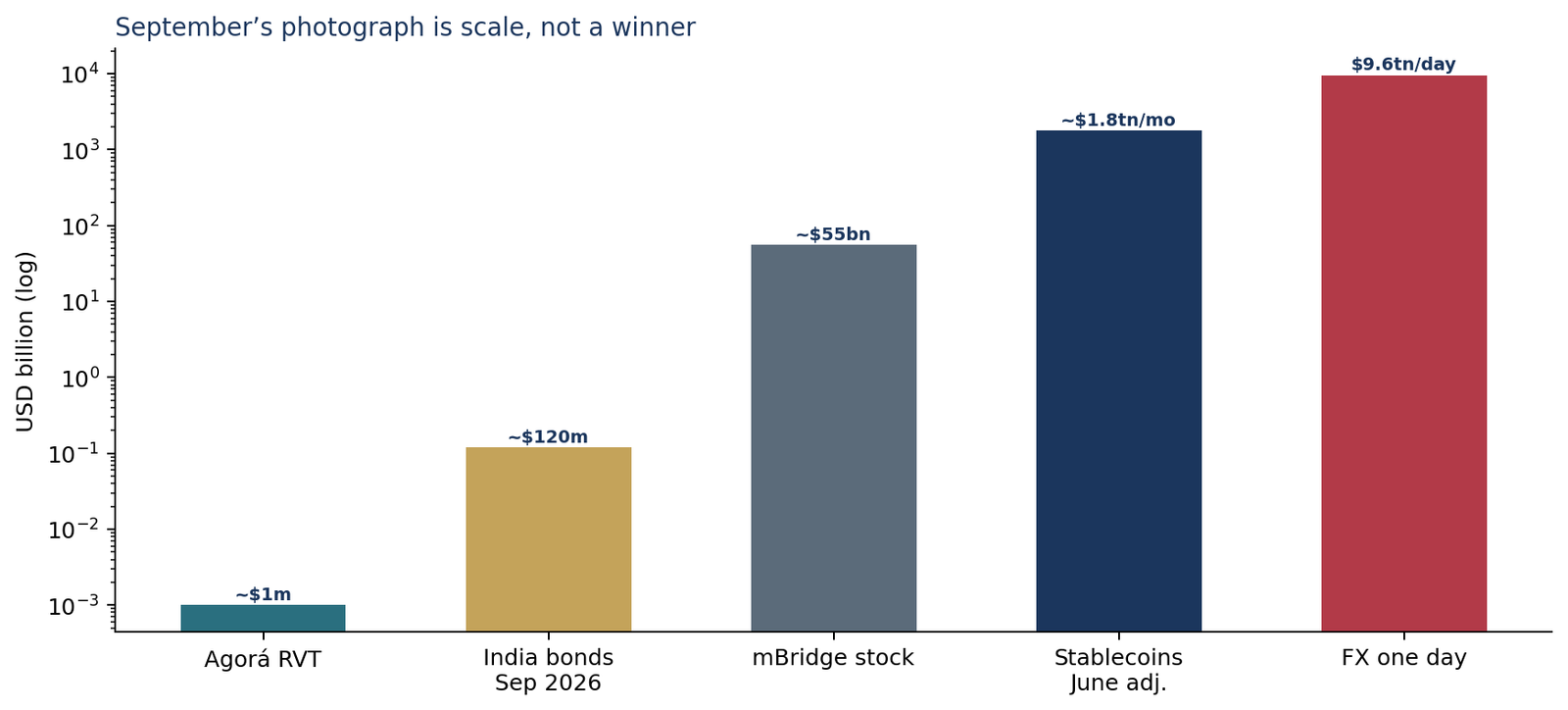
| Public rails trail wrappers on volume; lead on the asset | $1.8tn in a month versus public stocks in the tens of billions |
| The United States is many networks | TCH, Keystone, Cari, FIUSD - same banks, no shared rail |
| China is not joining | Hong Kong is a valve |
| Islamic / GCC is law-before-ledger | Standard 62 still draft |
| Incumbent cores rent the door | Overnight batch as sole book is what ages out |
| 2028 is the honest horizon | This week is the photograph |
Table 2. Eight sentences. One mechanism underneath: rational local answers, no shared authority.
Singleness first. Essay nine named it: a unit of currency is supposed to be a perfect substitute for itself, whichever bank, ledger or app holds it. If a euro on Pontes, a dollar inside a GENIUS coin, a deposit token on Agorá and an e-CNY on mBridge stop being substitutes at par in a real squeeze (weekend, wrong currency pair, no runbook) this series will not have been about modernising money. It will have been about partitioning it. The first hour of that failure will look like a basis, then a queue, then a rule that says this token is not that token. The Fund wrote terms of reference for a committee that does not exist. The committee is the missing object on this map.8
No referee can draw the join. The Fund has analysis and, outside a borrowing programme none of these protagonists need, no switch. The vendors have sidecars and a list of systems they will not connect, written by counsel rather than by a standard-setter. Essay ten’s unbuildable SKU is essay nine’s vacancy with a product code.
Public rails are behind private wrappers on volume and ahead on the settlement asset. One adjusted stablecoin month already dwarfs the cumulative public books this series has been able to cite. That is why pillar one sounds like catch-up. It is also why volume is the wrong crown. A wrapper can move a trillion and still fail the asset test the moment reserves, statute or an issuer wobble. A reserve token can look small and still be the only object that cannot default in its own currency.
The United States is many networks, not one architecture. Washington’s refusal of a public token did not leave a hole. It left a crowded private floor. TCH, Keystone, Cari, FIUSD. Overlapping banks. No join. Essay seven called that outcome in advance.
China is not joining. Hong Kong lets a state-approved trickle through. It does not connect mBridge to Agorá. Nothing this month moved that sentence.
Islamic and GCC work remains law-before-ledger. Standard 62 is still being rewritten. Fit is jurisprudential first. Scale will wait on the standard.
Incumbent cores survive as rent on the door. They do not survive as the only book once 24/7 is a supervisory expectation rather than a slide. Fiserv, FIS, Jack Henry and Temenos can collect that rent for years. The overnight batch as sole system of record cannot.9
2028 is the honest horizon: Pontes hours stretching toward 24/7, Appia as blueprint, TCH through a first live year, Japan’s plan on paper. September 2026 is the photograph taken on the walk.
Read the eight conclusions as one mechanism. Each institution in this series solved its own money-leg question competently, inside its mandate, its statute, its politics. Not one solved it with reference to the others. That is not a failure of a named central bank or a named vendor. It is what rational local action produces when nothing sits above it. Eleven times is how a single monetary system becomes several regional ones without anyone tabling a motion to split it.
Singleness was never a law of physics. It was a post-war, then a post-Bretton Woods, administrative achievement: deposit insurance, an RTGS window, a last-resort balance sheet, a court that treats one deposit as one deposit. Tokenisation did not invent a new threat to that achievement. It removed the pauses in which the achievement used to be repaired. An eighty-second ticket and a Sunday-morning shortfall do not share a lunch hour. The four supports Adrian listed in May (finality, the central settlement asset, standing liquidity, deposit insurance) still have to exist. They have to exist on a clock that no longer stops. No architecture in this series has tested that clock at scale. That is the honest limit of every “live” claim on this map, including Monday’s.
A professional wrap of the month, then, rather than a scoreboard. Tokenised markets in September 2026 did three things at once. They put a public wholesale cash-leg into production in the euro area. They put three Indian corporates through a CBDC-settled bond window that kept Demat law intact. They left the two global clubs unjoined and the three American deposit-token networks unjoined. The first two facts are progress. The third is the system. Progress inside a partition is still progress. It is not integration. Anyone writing the month as a takeoff is writing only the first two facts. Anyone writing it as a stalemate is writing only the third. The map has to hold all three, in that order, without a trophy paragraph at the end.
This series set out to map who provides the cash leg. It cannot make those legs one money. That was never the assignment. The assignment was the map. Here it is.
If a reader takes only one working rule off the table, let it be this. When a new tokenisation announcement arrives next year (a longer Pontes window, a TCH first ticket, a Japanese plan, another Indian bond, a vendor sidecar with a new name) ask two questions before asking whether the technology works. Who provides the cash leg. Who that cash leg will not talk to. The first question is the series. The second is the map. Most of the industry will keep answering only the first. The partition, if it hardens, will be built out of those half-answers, one competent local launch at a time.
The eleven essays were published between 7 and 25 September 2026. The architectures they describe will outlast the fortnight. The photograph will date. That is the correct order. Architectures first. The week second. A winner, if one ever appears, not in this series at all.
Sources and notes
1. ECB, Eurosystem brings central bank money to tokenised finance, 21 September 2026. Day-one market participants include ABANCA, BayernLB, Caisse des Dépôts, Cecabank, Deutsche Bank, DekaBank, DZ Bank, EIB, KfW, Memo Bank, NRW.BANK, Santander, Société Générale; Bundesbank onboarded as a market participant. DLT operators: Axiology, Cashlink, Clearstream, SWIAT. Dual model; 09:00-16:00; euro; one-off fees. Axiology uses permissioned code derived from XRPL; public XRP is not the cash asset.
2. Lagarde remarks around the 21 September launch / Eurogroup week: Pontes framed as bank-to-bank settlement of tokenised assets in central-bank money. Retail digital euro remains a separate legislative track; co-legislators still to finish the package; retail pilot not before 2027 on current public language.
3. REC Ltd, 7 September 2026: first SEBI-sandbox tokenised corporate bond, ~₹500 crore accepted at 7.30%, ~20-month tenor, bids ~₹796 crore. L&T 9 September: ₹500 crore at 7.4%, three years. IIFL Finance 9 September: ₹25 crore at 9.1%, two years. Combined ~₹1,025 crore. Settlement in wholesale e₹; holdings on Demat 2.0. Sitharaman, Global Fintech Fest, 11 September 2026: “what is the money leg made of?”
4. Bank of Japan, Central Bank Digital Currency Experiments: Progress Report on the Pilot Program (June 2026), published 11 September 2026. Mixed load 10,000 update + 40,000 inquiry TPS = 50,000 TPS on the pilot system. 500,000 TPS is a design assumption for social implementation, not a number the pilot printed. No technical knockout factor found. Issue decision still for public discussion. FSA/MoF/BoJ study group for stock and JGB chain: work toward early 2027, operations early 2030s (Nikkei, 26 August 2026). MUFG Canton JGB-repo PoC, August 2026 test, not a live market.
5. Visa Onchain Analytics / Allium, June 2026: adjusted stablecoin volume $1.79 trillion. BIS Triennial Survey April 2025: FX $9.6 trillion a day. Agorá RVT ~CHF 800,000 / ~$1 million, five testing CBs (essay 08). mBridge public stock ~$55.5 billion, ~95% e-CNY (essay 06).
6. TCH bank-led on-chain initiative, 5 June 2026, target often reported H1 2027. FIS Lyriq 29 April and Keystone 30 April 2026. Cari as a separate regional stack. Swift Ledger 9 July 2026; Citi live tickets September (essay 08, 10).
7. Notice 42 / mBridge (essay 06). AAOIFI Standard 62 still in draft (essay 05). EnsembleTX 24/7 aim by end-2026 target, not a confirmed production print as of this writing.
8. IMF Notes 2026/001 and 2026/006; Adrian May 2026 speech on the four supports of singleness (essay 09).
9. Vendor sidecar record: Lyriq “regardless of provider”; Woodforest off Finxact / Flagstar onto Finxact; Stablecore × Jack Henry (essay 10).
10. Essays 01–10 of this series for architectures, fees, hours, memberships and figures not restated here.