The Cash Leg · Essay 06 of 11 · People’s Republic of China · 14 September 2026
The Sovereign Counter-Model
How Beijing nationalised the primitive and outlawed the wrapper
Malaysia walked new pipes into an old house of law. China built the house, then locked the other doors.
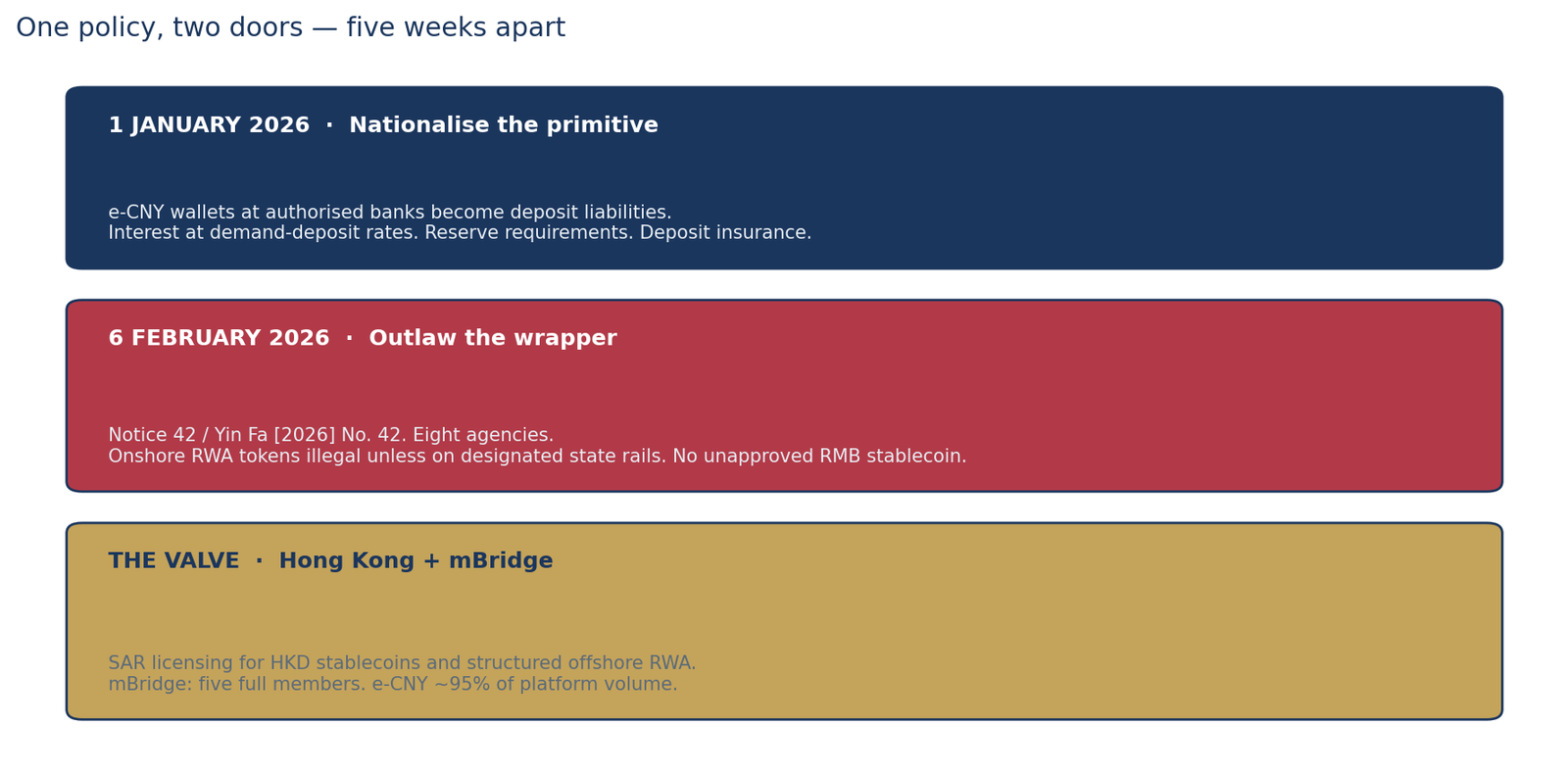
On 1 January 2026 the People’s Bank of China reclassified the digital yuan. For six years the e-CNY had lived as digital cash ~ M0, no interest, outside ordinary deposits. From that date, verified balances in authorised wallets became something else: an interest-bearing bank deposit, inside reserve requirements, inside deposit insurance. Five weeks later, on 6 February, eight national authorities led by the same central bank issued Notice 42. Cryptocurrency business stayed illegal. Real-world-asset tokenisation was defined, for the first time in Chinese regulatory history, and then almost entirely closed. Unapproved yuan-pegged stablecoins, onshore or off, were barred.1,2
Read the two dates as a contradiction and you will misread the policy. They are one move in two parts. January legitimised the state’s own digital money. February outlawed almost everyone else’s. Beijing is not missing from this series. It built the largest live digital-money system on earth and, in the same season, made nearly every private token of a Chinese asset illegal. London outsourced discovery. Frankfurt installed itself as operator. Seoul built a fiscal stack beside the banks. China took a fourth path none of the others tried: nationalise the primitive, criminalise the wrapper.
What Notice 42 actually does
International coverage has cried wolf on Chinese “crackdowns” since 2017. Notice 42 is not more of the same. Formally Yin Fa [2026] No. 42, it was issued by the PBOC, the National Development and Reform Commission, the Ministry of Industry and Information Technology, Public Security, the market regulator, the National Financial Regulatory Administration, the CSRC and the State Administration of Foreign Exchange all responsible for monetary policy, industrial policy, police, securities and foreign exchange, acting together. That list of signatories is the point. This was not a securities tidy-up.2
Substantively it does three things. First, it repeals and replaces the 2021 trading ban and restates the obvious: cryptocurrencies are not legal tender; crypto business remains illegal financial activity. Second, it defines RWA tokenisation (cryptography or a distributed ledger used to turn ownership or income rights into tradeable tokens) and states that the activity, plus the intermediaries and technicians who service it, is illegal unless it runs through designated, approved financial infrastructure. Third, it closes the offshore sneak path: no unapproved RMB-pegged stablecoin, and Chinese entities’ overseas tokenisation of domestic rights now sits under look-through filing with the CSRC, NDRC and SAFE. Same business, same risk, same rules.
The detail that separates this from a cartoon prohibition is the categorised structure. Blockchain is not banned. Tokenisation as a concept is not banned. What is banned is everything that does not go through a state-approved channel. That is a licensing monopoly, not a sandbox. The Western default is “try it, then we will see.” The Chinese default is “no, unless we already said yes.”
Hong Kong is where the approved channel actually breathes, and naming it stops a sloppy reading of the ban. The SAR runs its own securities and virtual-asset regime. The Stablecoins Ordinance took effect in August 2025. HSBC has already run a tokenised-deposit service for corporates. Onshore assets can, with structure and filing, reach a tokenised form and even an offshore book without tripping the mainland prohibition. Beijing gets both halves: a hard ban on ungoverned private activity touching the onshore system, and a single offshore valve whose terms the state still sets. That is not an accident of geography. It is the same pattern as mBridge’s participant list. Hong Kong is not a bystander in this architecture. It is the pressure valve.3
The two-tier bet inside the reclassification
The January reclassification puts China against a near-consensus at the BIS and the IMF. The orthodox fear about an interest-bearing CBDC is simple. If the instrument pays a competitive yield and carries the state, deposits leave commercial banks and credit creation hollows out at the worst moment. Every other central bank in this series designed around that fear. Wholesale tokens stay with supervised firms. Retail money stays a bank liability.8
China’s answer was architectural rather than a refusal to pay. The two-tier structure stayed: the PBOC issues e-CNY to authorised banks; the banks face the public. Interest is paid by those banks, at ordinary demand-deposit rates (widely reported around 0.05 percent at the large state names) and the balances fold into reserve requirements and deposit insurance exactly as a current account would. Non-bank distributors must hold 100 percent reserves against what they manage, so a payments firm cannot build a shadow deposit book on the state’s token. The yield itself is almost beside the point. What changed is the legal category. e-CNY is no longer a cash-like curiosity running beside the banking system. It is a stress-testable bank liability inside it.
Read generously, this is the first large CBDC built to compete with a stablecoin on function (always-on, wallet-native, a controlled yield) without leaving the sovereign perimeter. Read narrowly, it is an admission that six years of “digital cash” did not move the public off Alipay.
The domestic scoreboard is still a rounding error
State media likes the cumulative print. By late November 2025 the pilot, running since 2019–20, had put through about 3.48 billion transactions worth roughly 16.7 trillion yuan / $2.3 to $2.4 trillion, more than eight times the 2023 tally. Wallet counts sit in the hundreds of millions. The operator roster grew from ten banks at the start of 2026 to thirty by August. Those numbers are real. They are also the wrong denominator.4
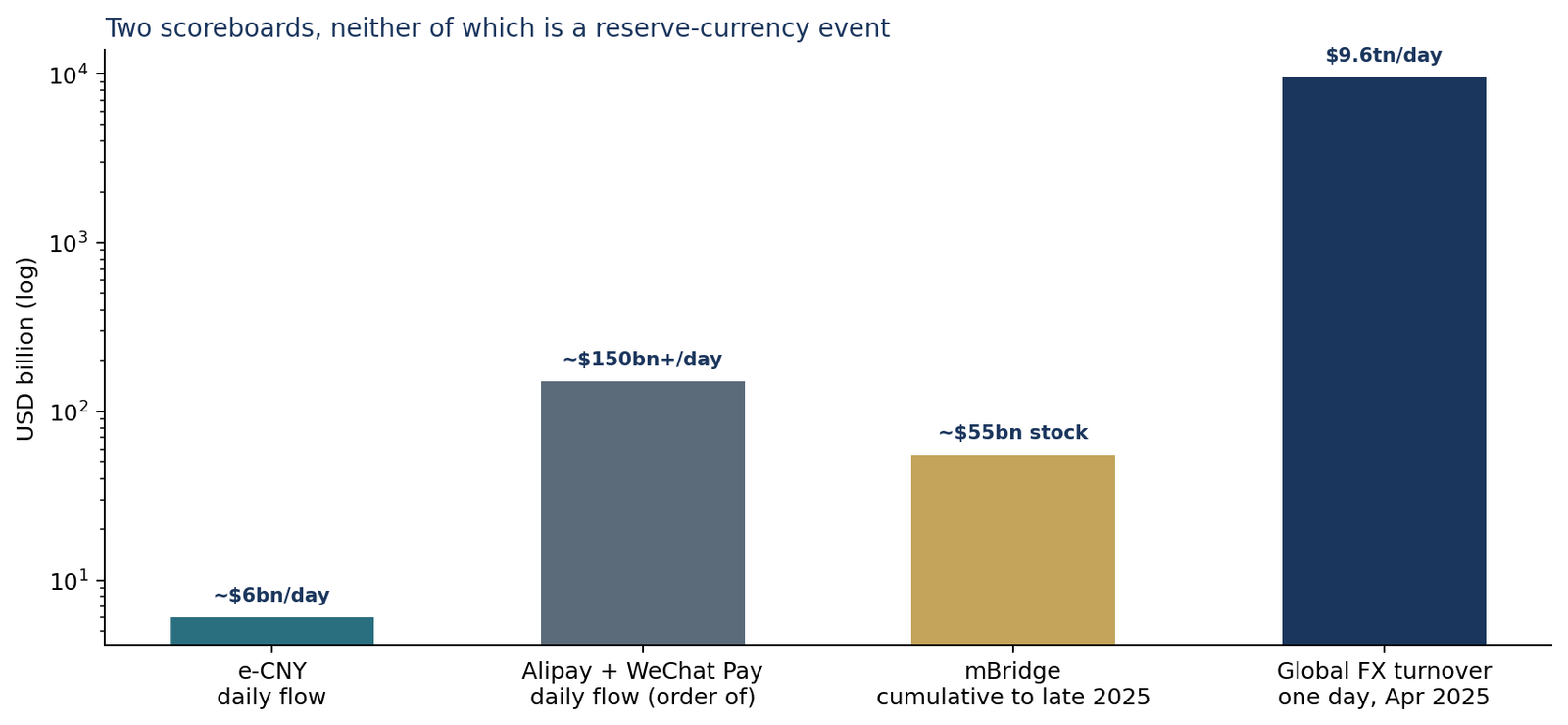
Foreign Policy’s June 2026 arithmetic is the one that belongs in this series. e-CNY flows on the order of $6 billion a day. Alipay and WeChat Pay together clear something north of $150 billion a day. China’s mobile-payments market is a multi-tens-of-trillions annual machine in which those two apps still hold more than 90 percent of the QR rail. The digital yuan’s entire six-year stock is smaller than what the super-apps process in a short run of weeks. Domestically the reclassification improved the instrument’s legal standing. It did not, on any evidence published this year, dethrone the private wallets it was built to discipline.
That gap is why January is strategy rather than a software patch. If the e-CNY cannot win on habit or network, competing on a legal category (deposit, insured, visible to the supervisor) is the move that remains. Whether 0.05 percent moves a decade of muscle memory is not a question this essay can close. The data so far argue for scepticism, not confidence.
The scoreboard that actually moves: mBridge
Where the strategy has traction is not the corner shop. It is Project mBridge, the multi-CBDC platform incubated by the BIS Hong Kong Centre with the PBOC, the HKMA, the Bank of Thailand and the Central Bank of the UAE, Saudi Arabia joining as a full member in 2024. By late 2025 the public benchmark (Atlantic Council and contemporaneous wires) was just over 4,000 cross-border transactions and about $55.5 billion cumulative, a 2,500-fold rise from the $22 million early-pilot print of 2022. The e-CNY was about 95 percent of settlement volume. That last ratio is the sentence. A platform with five flags on the door that settles almost entirely in one currency is not a balanced multilateral market. It is a yuan rail with guests.5
Later official and bank figures run higher and should be handled with care. The PBOC has cited prints approaching RMB 387 billion and, by mid-2026, near RMB 500 billion. In July the Bank of China advertised two jumbo legs (RMB 11.3 billion out of Shenzhen, a large Hong Kong-dollar inbound to Fujian) and a bank-reported total above RMB 600 billion. A bank that sits on one side of most tickets can double-count. This essay keeps $55 billion as the conservative public stock and treats the higher prints as evidence of direction, not as a new official total.
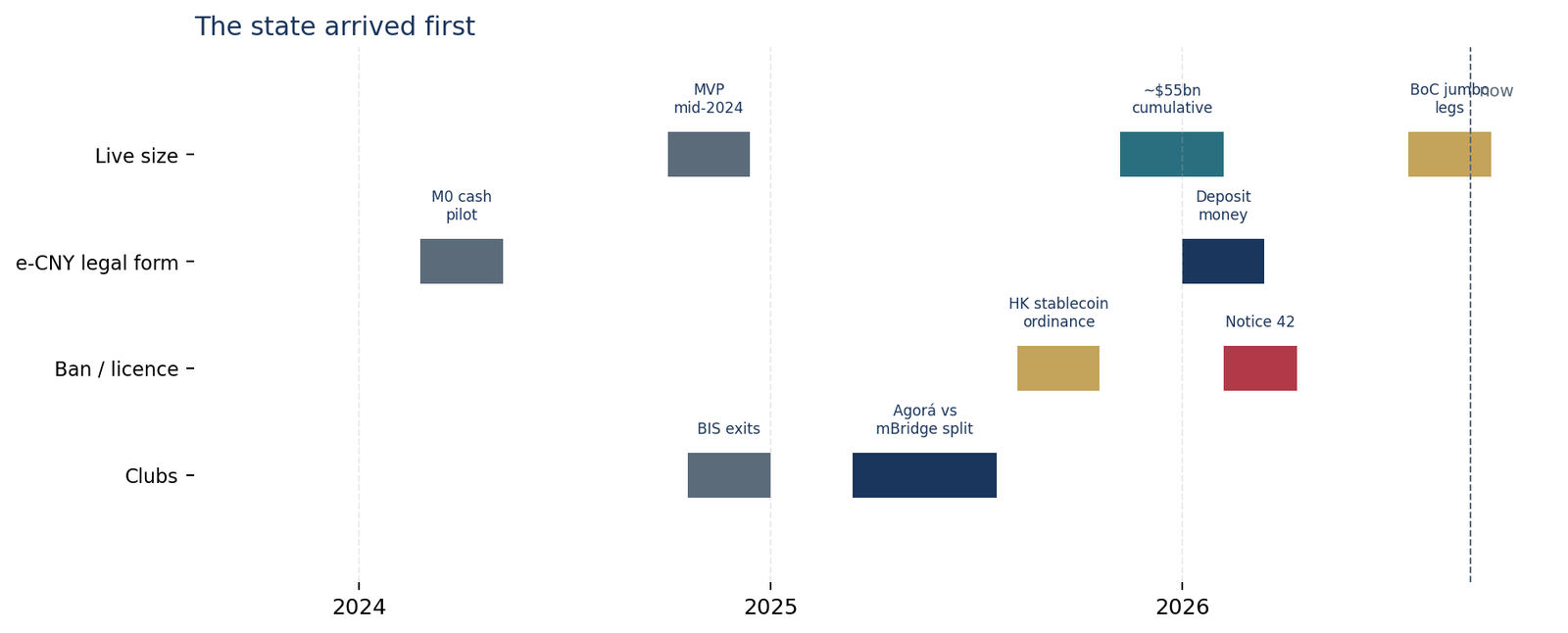
The BIS left in October 2024 and called it a graduation. Agustín Carstens added that mBridge was not a “BRICS Bridge.” The denial has had to do a lot of work. Subsequent reporting has tied some activity on or around the rail to sanctions-sensitive corridors; this series is not a sanctions desk and will not pretend to litigate those files. What can be said cleanly is structural. Correspondent banking is the pipe through which Western financial restrictions are applied. A CBDC platform that does not need that pipe cannot be switched off by the same switch. That fact does not require a motive. It is a property of the design.6
Full members remain five: mainland China, Hong Kong, Thailand, the UAE, Saudi Arabia. A long observer list has included the Bank of Korea, the ECB and others. Observer is not member. Some secondary write-ups described a 90-day 2026 test that pulled extra names into a trial. That is not accession. Korea’s live architecture in this series is Hangang plus Agorá. Putting Seoul on both clubs as if they were equivalent memberships would flatten a distinction the institutions themselves still draw.
| Rail | Participants | Scale | Currency mix |
|---|---|---|---|
| mBridge | PBOC, HKMA, BoT, CBUAE, SAMA (full). Long observer list. | ~$55bn cumulative by late 2025; later bank prints higher | ~95% e-CNY |
| Agorá | BoE, Fed NY, BdF, BoJ, BoK, Banxico, SNB (+ Canada later) | July 2026 real-value test ~CHF 800,000 | Six currencies; dollar CB absent from the live run |
| CIPS | RMB correspondent network | Orders of magnitude larger than mBridge | RMB |
Efficiency claims around the platform (settlement in seconds rather than correspondent days, sharp cuts in cost and in the time a compliance file sits on a desk) are why a Gulf or Southeast Asian central bank can justify a node without sharing Beijing’s politics. Saudi Arabia moved from observer to member in 2024 for a reason that can be commercial. Attractiveness to a treasury desk and usefulness to a sanctions desk can coexist in the same rail. This essay insists on both sentences.6
What this is not
It would be easy, and wrong, to read $55 billion and a five-year plan as the yuan displacing the dollar. Global FX turnover in the April 2025 BIS survey was $9.6 trillion a day. mBridge’s entire multi-year stock is a rounding error on a single session. Dollar invoicing, reserves and correspondent stock remain, in 2026, essentially unchallenged at the aggregate level. Foreign Policy’s summer verdict (de-dollarisation has hit a wall; Beijing can build instruments and cannot decree demand) belongs in this piece as a ceiling, not as an insult.7
What mBridge is, on its actual numbers, is a parallel wholesale rail that does not have to touch dollar correspondent banking. That is narrower than “yuan overtakes dollar.” It is also enough. A 2,500-fold rise in three years does not need to threaten reserve status to change the option set of any state that wants a ticket to clear where the old switch does not reach. Parallel is the word. Rival, in the reserve-currency sense, is not.
Two clubs, no join
After October 2024 the BIS poured the weight that had sat on mBridge into Project Agorá as in the public-private unified-ledger test this series has already used as Korea’s global seat and will treat properly two essays from now. The membership lists barely overlap. Agorá’s testing central banks are the Bank of England, the New York Fed, Banque de France for the Eurosystem, the Bank of Japan, the Bank of Korea, the Bank of Mexico, the Swiss National Bank. China is not in the room. None of those names is a full member of mBridge. That is not an interoperability bug. It is the design.10
Every central bank this series has sat with so far (London, Bern, Frankfurt, Seoul) lives in the Agorá orbit. China, Hong Kong, Thailand, the UAE and Saudi Arabia live in the other. The brief for this essay asked for Agorá’s antagonist. Here it is, in the literal sense: not a rival patch on the same problem, but a separate settlement architecture, growing fast on a closed guest list, with no current mechanism that connects it to the Western project at all.
Put the halves back together and the logic is legible. At home Beijing nationalised the primitive and shut the private wrapper. The super-apps still win the day. Abroad the same state took a BIS pilot, watched the institution walk off, and kept building. One scoreboard is a loss the official releases will not print. The other is a win most Western desks ignored until the cumulative number had too many zeros. Neither is a dollar funeral. Both are a fourth answer to the cash-leg question: the state is the only lawful tokeniser, and the offshore valve opens only when the state turns it.
The next essay turns to the one large economy that refused to build a public retail token at all, and handed the dollar’s on-chain life to private issuers under a federal statute instead. That is not the absence of a sovereign bet. It is the mirror of this one. Where Beijing nationalised the primitive, Washington licensed the wrapper and kept the public token off the table. The cash-leg question does not disappear when the central bank steps back. It just changes landlord.
Sources and notes
1. PBOC Action Plan for Further Strengthening the Digital Yuan Management Service System, effective 1 January 2026. Commercial-bank e-CNY wallets reclassified as bank deposit liabilities; interest paid at prevailing demand-deposit rates; balances enter reserve-requirement calculations; deposit insurance applies. Non-bank distributors required to hold 100 percent reserves. Deputy Governor Lu Lei, Financial News / official commentary, late December 2025–January 2026. Large state banks widely reported paying about 0.05 percent, matching ordinary demand deposits.
2. Yin Fa [2026] No. 42, 6 February 2026, jointly issued by PBOC, NDRC, MIIT, Ministry of Public Security, SAMR, NFRA, CSRC and SAFE. Repeals the 2021 virtual-currency trading notice. Defines RWA tokenisation; treats onshore RWA activity and related intermediary/IT services as illegal financial activity unless approved and run through designated financial infrastructure. Bans unapproved RMB-pegged stablecoins, including offshore issuance aimed at the mainland. Same-day CSRC guidelines on offshore asset-backed securities tokens backed by onshore assets.
3. Hong Kong Stablecoins Ordinance, in force August 2025: licensed fiat-referenced stablecoin issuance under HKMA. HSBC tokenised-deposit service for corporates, 2025, later Canton Network atomic-settlement pilots. Notice 42 leaves a filing path for certain offshore structures on domestic assets under CSRC/NDRC/SAFE look-through.
4. PBOC figures through November 2025, widely cited: about 3.48 billion e-CNY transactions, 16.7 trillion yuan cumulative (~$2.3–2.4 trillion). Wallet counts in official and Caixin tallies: on the order of 230 million personal and 19 million corporate wallets by end-2025. Network operators expanded from 10 banks at the start of 2026 to 30 by August. Foreign Policy, 24 June 2026: e-CNY daily flow around $6 billion against $150 billion-plus a day for Alipay and WeChat Pay combined.
5. Atlantic Council CBDC Tracker / contemporaneous reporting to late 2025–January 2026: mBridge more than 4,000 cross-border transactions, about $55.5 billion cumulative; e-CNY about 95.3 percent of volume. PBOC later cited figures approaching RMB 387–500 billion. Bank of China, July 2026: two jumbo legs (RMB 11.3 billion outbound from Shenzhen; a large HKD inbound to Fujian) and a bank-reported platform figure above RMB 600 billion — treat the $55 billion public benchmark as conservative and the bank print as not directly comparable.
6. BIS announcement, October 2024: project handed to partner central banks; Agustín Carstens called it a “graduation” and said mBridge is not a “BRICS Bridge.” Official BIS project page lists full partners as HKMA, Bank of Thailand, PBOC Digital Currency Institute, CBUAE and Saudi Central Bank. Observing institutions have included the Bank of Korea, ECB, Banque de France and others. Secondary reporting of a 90-day 2026 test phase is not the same as full membership.
7. BIS Triennial Survey, April 2025: global FX turnover $9.6 trillion a day. CIPS remains the large conventional RMB cross-border pipe; mBridge is a CBDC overlay, not a substitute for CIPS stock.
8. Orthodox CBDC-disintermediation debate: BIS and IMF writings on interest-bearing retail CBDC. China’s design keeps the two-tier distribution (PBOC issues to banks; banks face the public) and routes yield through the commercial-bank layer rather than paying it from the central-bank balance sheet.
9. 15th Five-Year Plan period (2026–2030) language on digital-currency infrastructure and cross-border use; PBOC 2026 workplan items on cross-border pilots. CBETS (Cross-border e-CNY Transfer Services) announced mid-2026 with additional institutional sign-ups.
10. Project Agorá (BIS/IIF): Fed New York, BoE, Banque de France for the Eurosystem, BoJ, BoK, Banxico, SNB, later Bank of Canada. July 2026 real-value test did not include the Fed. Forbes and others, May 2026: the two clubs are not interoperable by design.