The Cash Leg · Essay 01 of 08 · United Kingdom · 31 August 2026
The Neutral Engine
Why the Bank of England does not want to own tokenisation
When money and assets become tokens, the fight is not over the ledger, it is over the cash leg.
The risk-free asset in which the trade actually settles.
These series follow that question through the jurisdictions now answering it in public: the United Kingdom, Switzerland, the euro area, Korea, the United States, the BIS’s Project Agorá, the IMF, and the core-banking vendors that sit underneath all of them. Each piece has one job. This one is the glossary and the first wager: London, to remain unavoidable without becoming the operator.
In a converted floor off Threadneedle Street this spring, eighteen firms sat down to audition for a job that does not exist yet. Chainlink was there. So were Swift, the London Stock Exchange Group and the wholesale network Partior. Property platforms LMS and PEXA turned up, with a scattering of market-infrastructure names most depositors have never heard of. None of them were moving real money. None of them had won anything. They were reading for a role the Bank of England has invented and, crucially, has not promised to anyone: the synchronisation operator.
That is the Synchronisation Lab. It launched in spring 2026 when Sarah Breeden told City Week in May that it had “went live earlier this month” and runs about six months inside a simulated version of RT2, the Bank’s renewed real-time settlement engine. No real funds move. No licence is conferred by taking part. The Bank has said it is not obliged to act on anything the Lab produces.1 It is a rehearsal. Eighteen organisations try to solve the same problem eighteen ways before Threadneedle Street commits to a permanent design.
The posture of inviting everyone, promise no one, commit to nothing yet is not caution for its own sake. It is the strategy. While Switzerland has spent three years settling live tokenised bonds in wholesale central-bank money, and while the ECB is three weeks from switching on Pontes, the Bank of England is still holding auditions. The delay is deliberate. It is a bet about what the Bank should actually be for.
A short glossary
Four terms are used loosely in this market and tightly in this series.
RTGS - real-time gross settlement as in the ledger on which commercial banks hold accounts at the central bank and pay one another, one transaction at a time, in central-bank money. That money carries no commercial credit risk. The UK’s renewed system, live since April 2025, is RT2.
Synchronisation makes a movement of money in RT2 conditional on a matching movement of an asset somewhere else as a tokenised bond, a title deed or a foreign-currency payment. Funds or assets are first locked, then released together or not at all. The trade name for that is atomic settlement. It is the technical answer to an old question: what happens if one side delivers after the other has already paid.2
A synchronisation operator is the intermediary this creates. It sits between RT2 and an external ledger and runs the lock-and-release. It is a role, not yet a company. The Lab exists to see who might fill it.
An omnibus account is a special RTGS account, introduced in 2021, that lets a non-bank operator pool many participants funds at the central bank. It is the legal precedent for everything the Lab is now testing in public. Fnality used one to make live sterling payments in December 2023.3
Three layers and a vacancy in the middle
Strip the jargon and the Bank is building three layers. Only one of them is up for grabs.
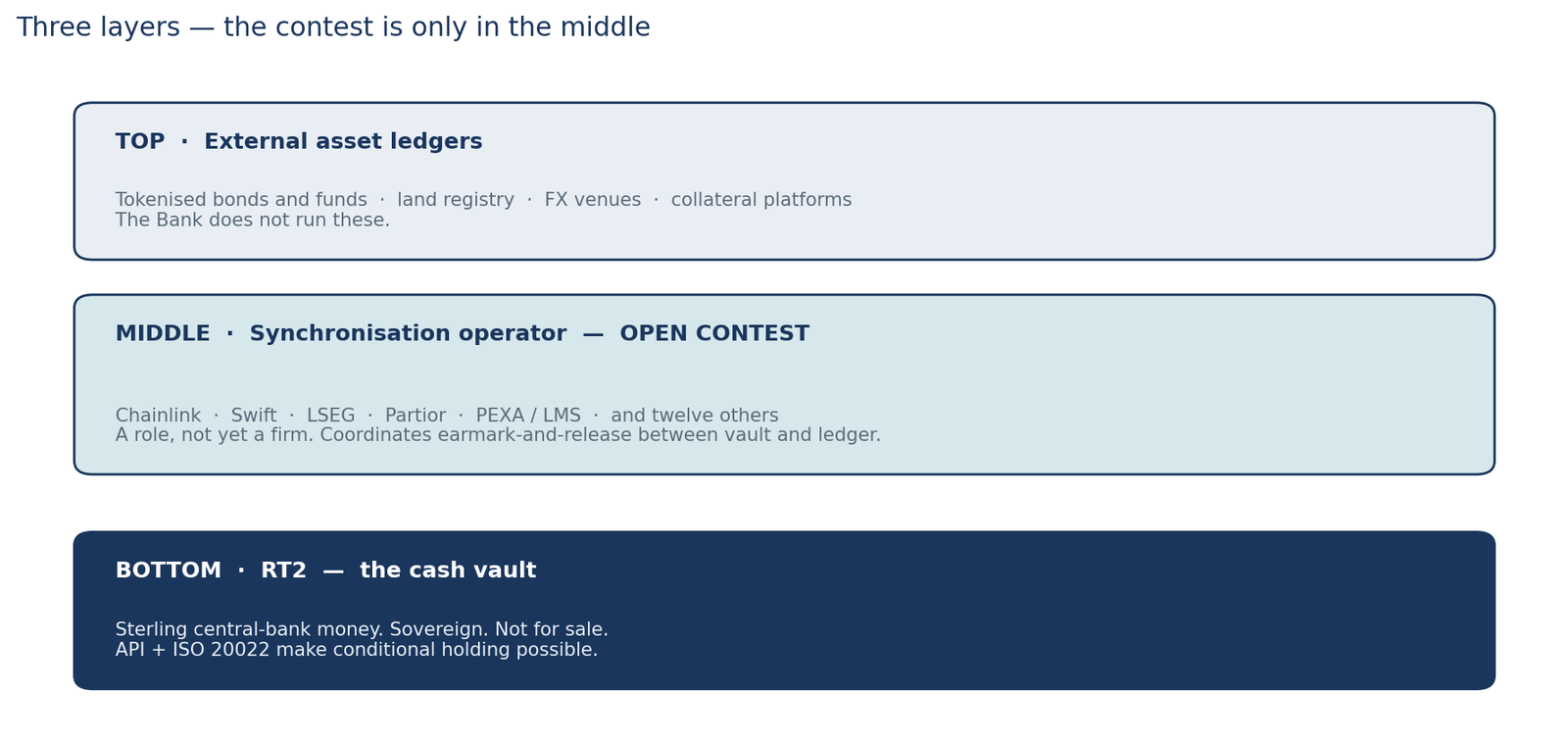
The bottom layer is RT2 itself as in the cash vault. The Bank will not hand this to anyone. It is sovereign infrastructure. RT2’s job is still to move sterling between accounts. What is new is an API-enabled, ISO 20022 architecture that can hold funds conditionally rather than only transfer them outright.
The top layer is a widening set of external asset ledgers: tokenised bonds and funds, digital land-registry records, FX systems, collateral platforms. The Bank has no intention of running them. They belong to markets, exchanges and vendors.
The middle layer is the decision that is not a decision. Rather than build the operator in-house or pre-select a winner, the Bank has opened a contest. Chainlink is testing decentralised coordination. Swift and LSEG are testing securities-settlement and margin workflows. Partior is testing multi-bank wholesale flows. Quant has shown multi-bank treasury rebalancing packaged as a single lock-and-release. These are not partners on a shared build. They are rivals for a job the Bank has not yet agreed to fill.4
Even the wiring is still open. The Bank has published two candidate models for how an operator talks to RT2: in one, the operator sends the earmark itself; in the other, the RTGS account holder sends it under the operator’s direction. Further models are being considered as the Lab reports back. That is not a consultation dressed around a preferred design. It is genuine indecision, down to who is allowed to speak to the ledger.
The use cases are not only capital markets. LMS and PEXA are being tested on house purchase and remortgage, wired toward HM Land Registry. Transpact lists property among its demonstrations. That line runs back to Project Meridian in 2023, when the Bank, the BIS Innovation Hub and the Land Registry showed a purchase in which funds in RTGS and the change of title moved as one event: instead of a solicitor releasing money on trust hours or days before the register moved. It is unglamorous next to a tokenised gilt. It is also the point: synchronisation is being designed as a general-purpose switch for anything that must happen at once, not as a bond product.
| Participants | Use case | What it tests |
|---|---|---|
| Chainlink, UAC Labs | Decentralised coordination of central-bank money and DLT securities | Public-chain grammar against a central-bank vault |
| Swift | Cross-border spot FX | Incumbent messaging sitting on a new settlement switch |
| LSEG, GBTD | Multi-purpose orchestration | Exchange group trying on the operator role |
| Partior, ClearToken | Wholesale payments and collateral | Bank-owned networks, not vendors |
| Baton, Ctrl Alt, Monee | DvP for tokenised securities; FX / intra-day repo | The capital-markets case |
| LMS, PEXA, Transpact | House purchase and remortgage | Meridian’s land-registry line, still alive |
| OSTTRA, Tokenovate | Conditional margin | Derivatives plumbing |
| Atumly, Nuvante, Quant | Multi-money issuance; corporate liquidity | Treasurer use cases, not trader use cases |
The load-bearing fact is not tokenisation. It is FX
None of this is a rational strategy unless you know what already flows through London. A neutral horizontal layer only pays if you already sit in the middle of other people’s trades.
The United Kingdom remains the world’s largest foreign-exchange centre. In April 2025 it cleared 37.8 percent of global FX turnover ($4.75 trillion a day) according to the BIS Triennial Survey. That is a shade below the 38.0 percent of 2022 and well below the 43 percent peak of 2019, but it is still more than the United States and Singapore added together. In OTC interest-rate derivatives the UK share rose to 49.6 percent.6
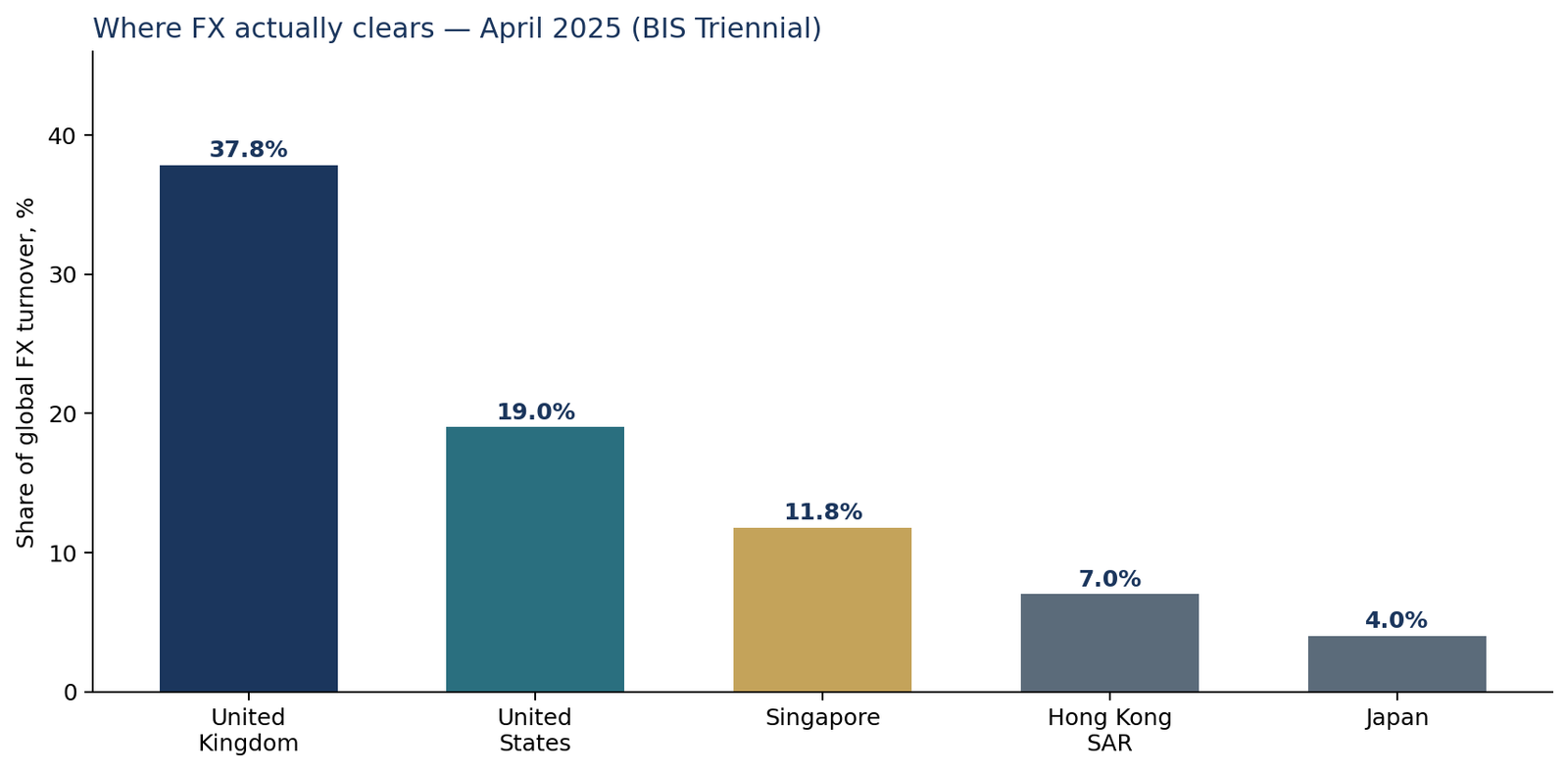
If London is where the world converts currency, a layer that can settle any asset against sterling central-bank money is not a speculative product looking for a market. It is plumbing under a market that already exists. That is why the Bank’s most advanced synchronisation work has not been about securities. It has been about foreign exchange.
Project Meridian FX, run from the BIS Innovation Hub’s London Centre with European central banks, tested synchronisation as a way to cut Herstatt risk which is the chance that one side of a currency trade pays and the other defaults before paying back. On 13 November 2025 the Bank extended that work into a three-way experiment with the Monetary Authority of Singapore and the Bank of Thailand, using simulated RTGS and DLT environments to test payment-versus-payment across different legal systems, time zones and technical stacks. Tom Mutton, the Bank’s Director of Fintech, framed it as a possible new FX settlement channel for an open global system. That is plumbing language, not product language.7
Hold the contrast for later essays, but hold it now as a single sentence. Switzerland’s commodity cluster justifies a vertical stack tied to physical trade. London’s FX franchise justifies a horizontal switch tied to nothing in particular and this is because almost everything, eventually, has to be priced and settled in a currency, and a disproportionate share of that already happens here.
| Jurisdiction | Cash-leg choice | Operator model | Status / timing |
|---|---|---|---|
| United Kingdom | Sterling stays in RT2; external ledgers stay external | Contested private operator | Lab 2026; capability 2028 |
| Switzerland | Wholesale CBDC issued onto SDX | SNB + SDX stack | Production since Dec 2023 |
| Euro area | T2 trigger and/or Eurosystem DLT tokens | Eurosystem itself | Pontes 21 Sep 2026 |
| Korea | BoK wholesale rail under bank deposit tokens | State + nine banks | Hangang Phase 2, Sep 2026 |
| United States | Bank deposits on a private shared ledger | The Clearing House | Target H1 2027 |
The rest of the UK payments diary belongs in the same frame. CHAPS is planned to open at 01:30 from September 2027. A consultation this year set out a path toward near-24/7 settlement. Synchronisation that only works inside today’s CHAPS window is a half-product: tokenised asset ledgers do not sleep. Extending hours is how the Bank keeps the cash leg awake enough to remain the one people use. It is also how it stays aligned with a network it does not control. In late August the Bank deferred its entire November 2026 RTGS standards release after Swift delayed a messaging change. The stated reason was global interoperability. That is the character of the institution in one administrative act: it will slip a national date rather than break the shared gauge.
Who owns the 2028 decision
“The Bank of England” is not one person. The governance trail is part of the argument.
Day-to-day responsibility for RT2 and CHAPS sits with the RTGS/CHAPS Board, chaired since May 2025 by Victoria Cleland, Executive Director for Payments. Sir Dave Ramsden, Deputy Governor for Markets and Banking, still chairs the RTGS-CHAPS Executive Board that signs off budget. The public date sits higher: on 19 May 2026, at City Week, Sarah Breeden, Deputy Governor for Financial Stability, confirmed live delivery of a synchronisation capability, targeted for 2028. That is a Deputy Governor’s name on a year.8
The condition is the word capability. The Lab’s terms say the Bank need not act on the output and that participants have no decision rights. The findings report, due after the Lab closes, will inform the next build. It is unlikely to crown a winner. The Bank is still testing who may instruct RT2. A single reference architecture by December 2026 would be a surprise. A narrowing of viable models, with the contest running into 2027, would not.
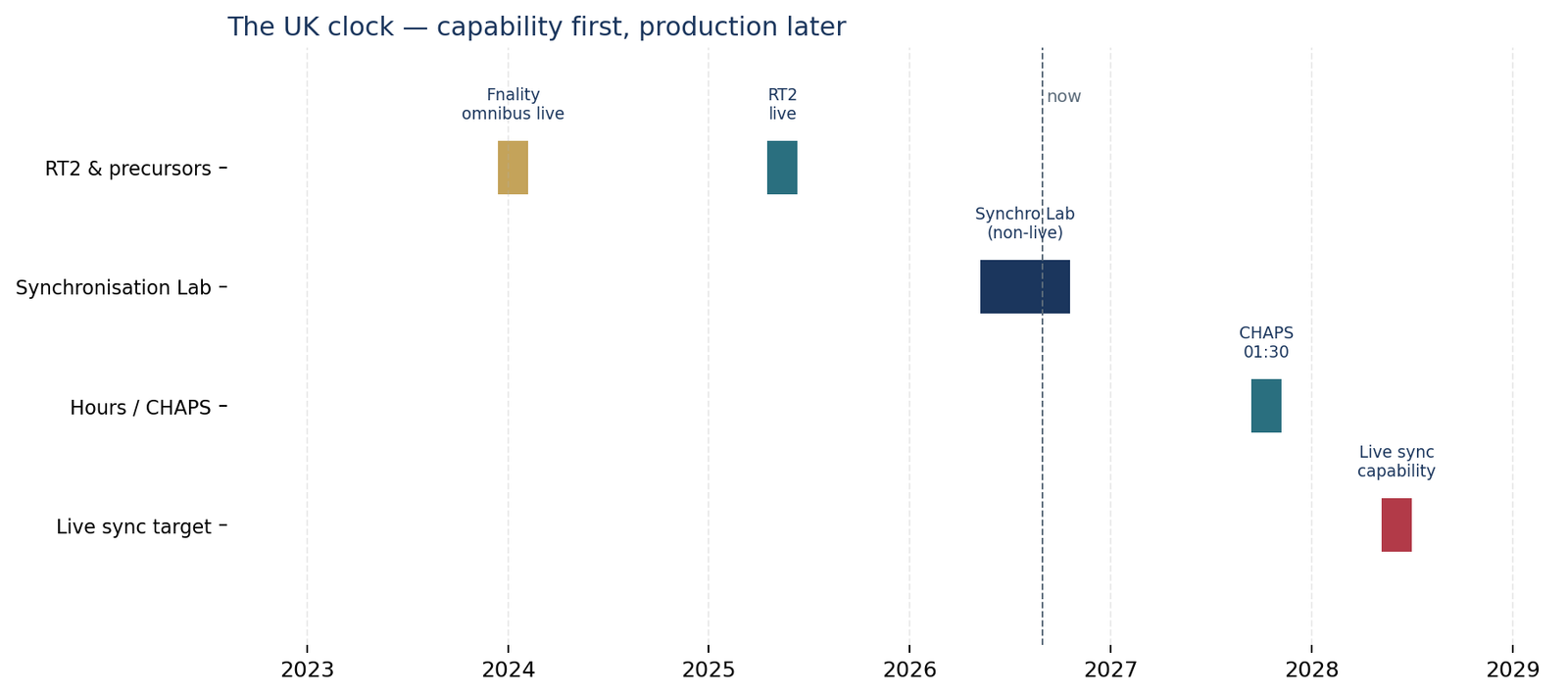
| Date | UK milestone | What it creates |
|---|---|---|
| 2021 | Omnibus-account policy | A tokenisation strategy |
| Dec 2023 | Fnality live sterling payments via RTGS omnibus | General-purpose synchronisation |
| Apr 2025 | RT2 goes live | An operator layer |
| May 2026 | Synchronisation Lab opens (18 firms, non-live) | Production |
| Sep 2027 | CHAPS from 01:30 (planned) | 24/7 finality |
| 2028 | Live synchronisation capability (Breeden) | A chosen architecture, or a chosen firm |
None of this is without a precursor. In December 2023 Fnality (backed then by Lloyds, Santander and UBS among a wider shareholder list) became the first holder of a Bank omnibus account and completed live payments that digitally represented funds held at the central bank, settled through CHAPS. It was a narrow, single-purpose rail, not a general switch. It later received settlement-finality designation for a DLT system. What the Bank filed away was simpler: a non-bank operator can sit between commercial participants and central-bank money without the system falling over. The Lab is that experiment, opened to competition.
There is an external check. The National Audit Office reviewed the RTGS Renewal Programme that delivered RT2 and presented findings to Court in December 2025; internally the review was described as positive on the core aim of a modernised RTGS. Independent members now make up half the RTGS/CHAPS Board, with one chairing the Board Risk Committee. Large programmes still slip (the Bank deferred its November 2026 RTGS standards release when Swift delayed a messaging change) but synchronisation is at least being watched by people paid to say so when it is late.
The road not taken, in one paragraph
The European Central Bank has chosen the opposite governance. Pontes, targeted to go live on 21 September 2026, installs the Eurosystem itself as the link between market DLT platforms and TARGET Services. That contrast is a later essay. Hold only this: two large central banks looked at the same cash-leg problem and disagreed about who may stand in the middle of it.
The wager
Here is the uncomfortable part, and the piece is dishonest without it. The Bank’s live synchronisation capability is aimed at 2028. Pontes is aimed at 21 September 2026. Korea’s Hangang Phase 2 is due, the same month, to run live deposit-token flows (including programmed public subsidies) across nine banks. It is not a finished retail digital won already in general circulation; treating it that way would flatter Seoul and insult the reader. Switzerland has been settling real bond issues in live wholesale CBDC since December 2023. On a calendar, London is not first, not close to first, and appears comfortable with that.9
What the Bank is betting is that being early matters less than being unavoidable. An operator built for one first use-case wins a headline. An operator built to plug into the world’s dominant FX clearing house, tested against real regulatory friction across three jurisdictions, and left replaceable if a better candidate appears, is a bet on relevance that compounds. The 2028 date is not proof the Bank is behind. It is proof the Bank thinks it does not need to rush, because whoever eventually wins the right to call themselves a synchronisation operator will still, in the end, have to plug into RT2 to touch the most heavily traded currency in the FX market. That is a wager on incumbency, dressed as patience. It is, at minimum, coherent.
It is also a wager with a visible hole. Patience only compounds if nobody builds a credible alternative route to sterling liquidity in the meantime. Fnality’s own stated ambition is to replicate its sterling system in dollars and euros as a private rail sitting alongside RT2 rather than only depending on it.10 Nothing in the Bank’s current design rules that out. If the eighteen firms in the Lab conclude they can synchronise assets against one another’s platforms without RT2 at every step, the horizontal bet stops looking patient and starts looking like a vacancy nobody was in a hurry to fill. The Bank’s confidence rests on an assumption: that central-bank money will remain the trust anchor participants prefer, even when a faster or cheaper private token exists. Four centuries of institutional credit make that assumption reasonable. They do not make it a law. The next seven essays test it against very different national bets on the same question.
NEXT IN THE CASH LEG
02 The Vertical Stack - Switzerland. The only production control case: SNB wholesale CBDC on SIX Digital Exchange, live since December 2023, and why a small jurisdiction could go vertical when London would not.
Then: 03 ECB · 04 Korea · 05 United States · 06 BIS / Agorá · 07 IMF · 08 Vendors.
Sources and notes
1. Bank of England, Synchronisation Lab. Eighteen organisations; non-live environment; about six months from spring 2026. Sarah Breeden, speech at City Week, London, 19 May 2026: the Lab “went live earlier this month.”
2. Bank of England, “What is synchronisation?” and RTGS Future Roadmap. Atomic settlement means an all-or-nothing earmark-and-release across two ledgers.
3. Bank of England omnibus-account policy, 2021. Fnality, “Fnality unveils Sterling payments in a world-first,” 14 December 2023; Reuters, same date. Dave Ramsden, “Renewed RTGS,” 29 April 2025: first central bank to onboard a private DLT-based payment system.
4. Bank of England Synchronisation Lab participant list and published use-case notes: Transpact, LMS, PEXA, Baton Systems, Ctrl Alt, Monee, ClearToken, Partior, OSTTRA, Tokenovate, Swift, Atumly, Nuvante, Quant, LSEG, GBTD, Chainlink, UAC Labs.
5. Project Meridian, BIS Innovation Hub London / Bank of England / HM Land Registry, 2023: synchronised house purchase against RTGS.
6. BIS Triennial Central Bank Survey, April 2025; Bank of England, UK results, 30 September 2025. UK FX turnover $4,745 billion a day; 37.8 percent of global turnover (38.0 percent in 2022). UK share of OTC interest-rate derivatives: 49.6 percent.
7. Project Meridian FX, BIS Innovation Hub London with European central banks. Extension announced 13 November 2025: Bank of England, Monetary Authority of Singapore and Bank of Thailand, joint media release.
8. Sarah Breeden, City Week, 19 May 2026: live synchronisation “targeted for 2028.” Bank of England, RTGS/CHAPS Industry Forum summary, 4 June 2026: 2027 preparations for a live service; CHAPS from 1.30am in September 2027. Victoria Cleland has chaired the RTGS/CHAPS Board since May 2025.
9. Ledger Insights, 4 August 2026, and Clearstream, 19 August 2026: Pontes initial launch targeted at 21 September 2026. Bank of Korea / Hangang Phase 2 materials: live deposit-token testing from September 2026 with nine banks and programmed public-subsidy flows — not a finished retail CBDC already in general circulation. Swiss National Bank / SIX: Helvetia Phase III in production from December 2023, extended at least to 2027.
10. Fnality public materials, December 2023: stated ambition to establish payment systems in US dollars and euros after sterling. Settlement-finality designation for the DLT system followed in 2024.