The Cash Leg · Essay 05 of 11 · Malaysia and the GCC · 11 September 2026
The Asset-Backed Mandate
Why Islamic finance does not need tokenisation in order to believe in it
The first four essays asked who is allowed to provide the cash when the asset is already a token. This one asks a prior question: what the cash is allowed to be.
On 27 August 2026, CIMB Islamic Bank settled RM1.38 billion (about $342 million) of tokenised sukuk against tokenised deposits, inside a RM1.68 billion issuance under its existing Senior Sukuk Wakalah Programme. Twelve institutions took the tokenised tranche. The remaining RM300 million went out as a conventional sukuk, side by side, as a built-in control group. The book had forty-six investors and was 1.73 times covered. Pricing was on 19 August; settlement was eight days later, inside Bank Negara Malaysia’s Digital Asset Innovation Hub, with the Securities Commission already on the call about what comes next.1
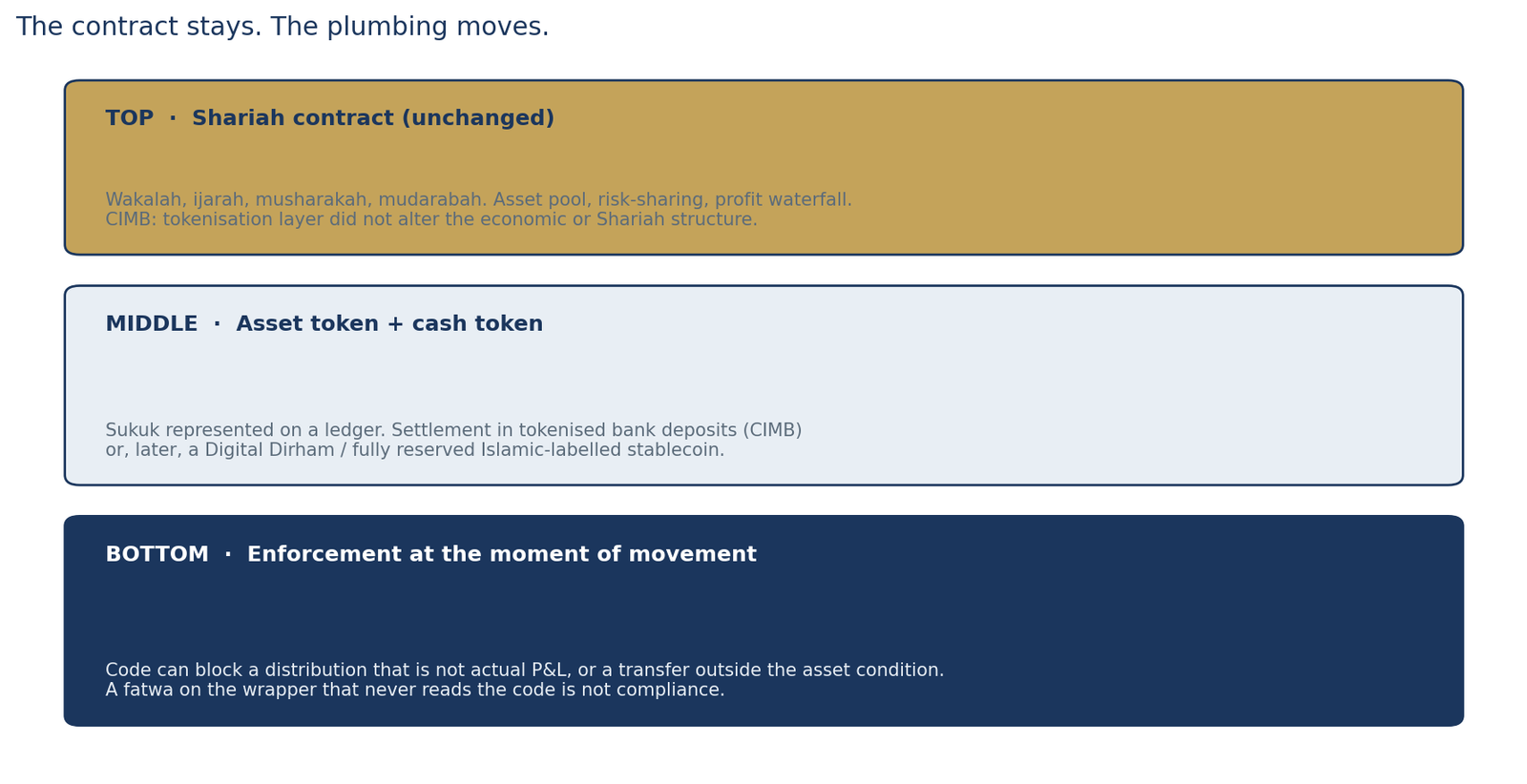
CIMB’s own statement contains the sentence this essay is built around: the tokenisation layer did not alter the underlying economic or Shariah structure of the sukuk. That sentence is doing more work than it looks. Every other project in this series has been, in some sense, an argument about speed as in atomic delivery-versus-payment instead of overnight reconciliation, fewer buffers, fewer messengers. CIMB is making a narrower claim. The wakalah agency contract, the identified asset pool, the profit waterfall; none of that moved. What moved was the plumbing underneath it. The distinction between the contract and the plumbing is where the argument lives.1
Sylvia Wong, who runs financial institutions and tokenisation inside CIMB’s wholesale bank, put the ambition in incremental rather than revolutionary terms. The bank can already move RM100 instantaneously, she said. The open question is whether that same deterministic settlement holds at RM100 million can do an order of magnitude that stresses liquidity, counterparties and operational controls in ways a retail transfer never does. The RM300 million conventional slice was not an afterthought. Some of the forty-six investors were not ready to take a digital format. That is not a failure of the pilot. It is evidence that the market, even in the deepest sukuk jurisdiction on earth, is still choosing the old rail when it wants to.2
This essay is not trying to prove that tokenisation makes Islamic finance more halal. It is trying to prove that a compliant structure, once built, can move at institutional scale without anyone having to touch, weaken or reinterpret the contract to get there.
The thesis, without ornament
Islamic finance already prohibited most of what conventional tokenisation is now sold as solving. Riba rules out interest dressed as yield which is the thing that made stablecoin farming and most of DeFi controversial even by conventional standards. Gharar rules out the unverifiable counterparty risk that atomic settlement is supposed to kill. Maysir rules out pure price-wagering. None of this was written for the tokenisation moment. It is fourteen centuries old.
What is new is not the rule. It is the place where the rule can be enforced. Classical practice has always relied on structure, drafting and a board’s sign-off at issuance and then, largely, on trust and a later audit to confirm the instrument kept behaving. A murabaha or a wakalah can be perfect on paper and still drift, in the operations room, toward a disguised interest-bearing loan. That drift is a documented complaint from more conservative scholars, including voices around AAOIFI itself. A smart contract changes the moment of enforcement. A distribution can be written so that it simply will not execute unless it reflects an actual profit-and-loss outcome. A payment can be written so that it cannot leave the asset-backing condition it was issued against.
Read that way, tokenisation is not Islamic finance borrowing a Silicon Valley toy. It is the arrival of a tool precise enough to enforce a set of rules the tradition has held for a very long time, at the exact moment the money moves rather than in a memo afterwards.
Ending “halal crypto”
A parallel industry has grown up next to this work, and casual coverage treats the two as cousins. They are not. Search for “halal crypto” and the results are a retail cottage: coins that pass a negative screen (no interest mechanism, no gambling venue, no alcohol or adult-content token) and then declare the result permissible, sometimes with a scholar attached, sometimes with one who would not survive a serious board.
A retail token passing a negative screen is a wrapper decision: does the asset avoid a list. A sukuk is a positive, structural decision: does the instrument represent genuine beneficial ownership in an identified pool, with investors bearing real risk and sharing real profit and loss, under a named classical form. Mufti Taqi Usmani, who chairs AAOIFI’s Shariah board and remains the most cited living authority in this market, has treated most cryptocurrency as falling outside mal (wealth in the technical sense) altogether. That is the same institution whose standards CIMB, the Saudi CMA and every serious issuer in this essay answer to. The honest framing is not that tokenised sukuk is a conservative cousin of “halal crypto”. They are doing different jobs. One of them has a governance structure that can stand under a $342 million institutional book. One of them, mostly, does not.4
The scholarly fight that stays open
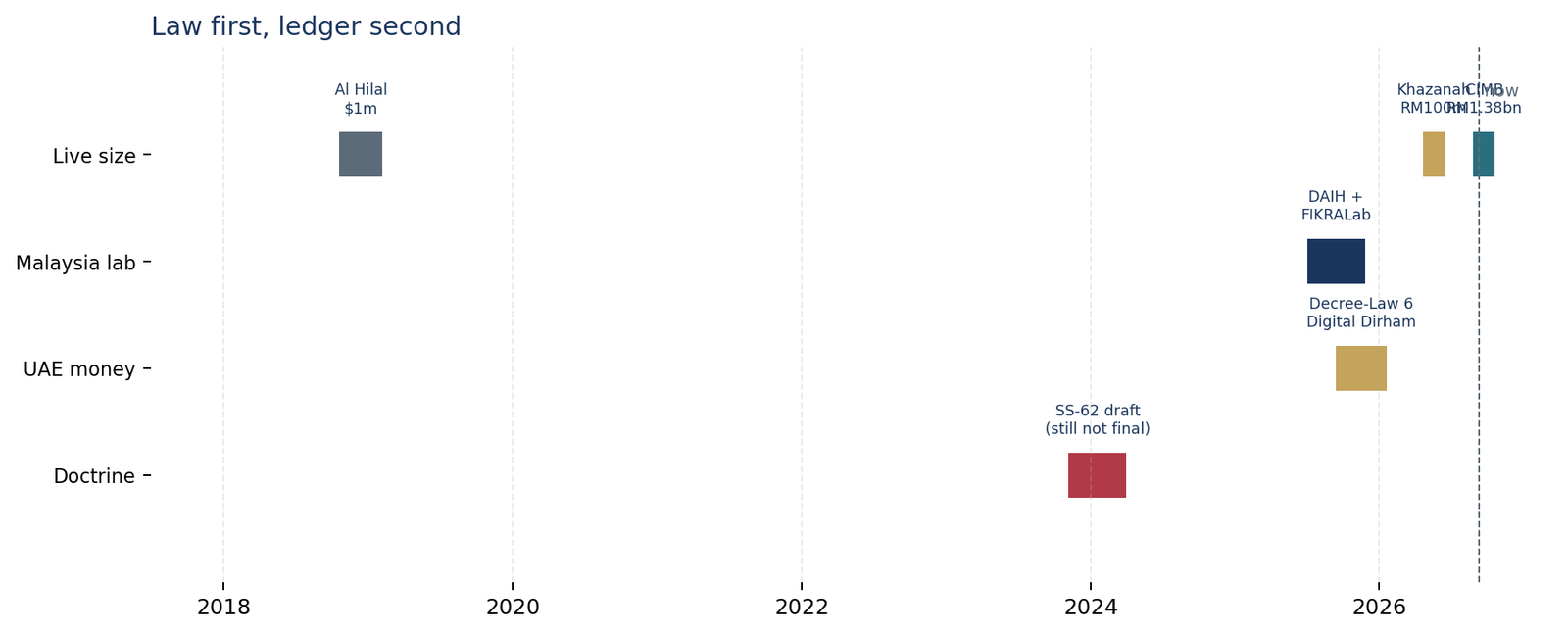
None of this means the institutional side is settled. AAOIFI’s Shariah Standard No. 62, on sukuk, is still a draft. The exposure text went out in November 2023. Consultation was extended more than once. In April 2025 AAOIFI said, in public, that the board was amending the first draft in light of industry comments and that the standard had not been finalised. By late 2025 the file was widely described as on hold pending another round with central banks, large issuers, rating firms and counsel. The direction of the draft is not subtle. It pushes toward genuine transfer of ownership to a bankruptcy-remote vehicle, real risk-sharing, and a rejection of structures that are, in substance, debt pools wearing an Islamic contract. If that text ever lands as written, a meaningful share of existing issuance would need restructuring, not relabelling.4
Tokenisation does not resolve that fight. It raises the stakes. A smart contract makes visible, in executable form, exactly what a sukuk does at each distribution such as the scrutiny a debt-pool-dressed-as-equity structure has historically been able to bury in annexes. Fitch, entering 2026, listed “shifting Shariah standards” as a monitored risk to the market. That is not a journalist’s flourish. It is a rating agency watching Standard 62 the way this series watches Pontes.
There is a second, narrower constraint that maps directly onto one of tokenisation’s favourite promises. Bay al-dayn (the restriction on trading debt for gain) limits how freely a sukuk that is mostly receivables can be resold. Trading a debt claim at anything other than face edges toward riba in the conservative readings. A conventional bond’s pitch is liquidity at any price the screen prints. A sukuk with meaningful debt-pool characteristics cannot make that same promise, no matter how fast the rail underneath becomes. AAOIFI’s guidance here is not a bug to be patched. It is a ceiling on how far the 24/7-liquidity story is allowed to travel inside a structure that is still trying to be compliant.10
Then there is a risk this series has not had to carry until now: what happens when the code is wrong. A drafting error in a prospectus can be corrected, litigated or waived. A bug in a deployed distribution contract may already have paid, irreversibly, before anyone reads the log. Nothing in fourteen centuries of fiqh anticipated a bargain that executes itself and cannot be un-executed. White & Case’s 2025 note on tokenised Islamic products put the rule in language this series should steal and keep: the code implements the legal bargain; it does not replace it. Override rights for oracle failure and emergency pause are not a betrayal of the technology. They are how a self-executing contract stays inside a legal system that still has courts.
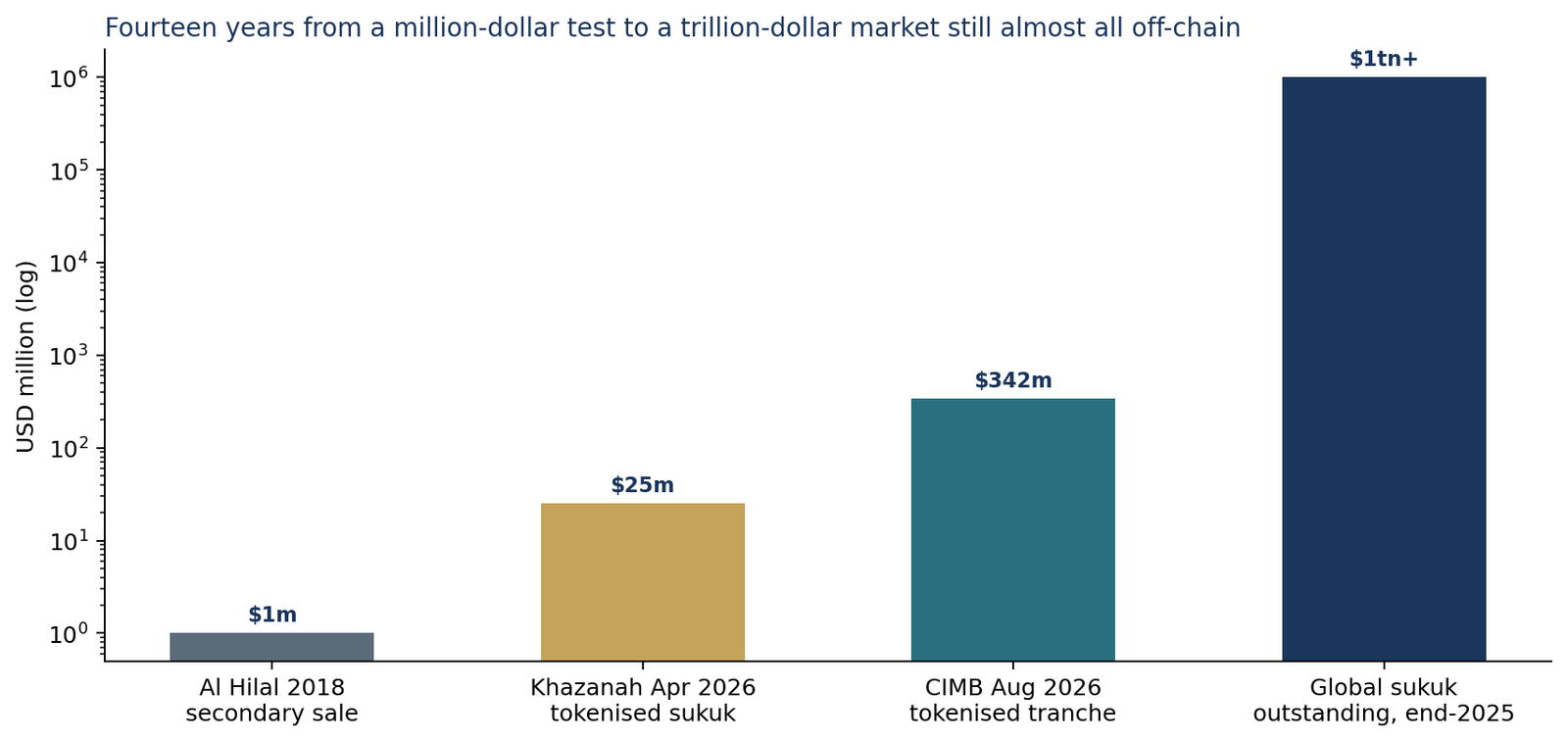
The gap between early pilot and institutional pressure is not theoretical. Al Hilal Bank’s November 2018 secondary sale (a $1 million slice of a $500 million sukuk, on a chain, with Jibrel, out of ADGM) proved the gesture. Blossom’s SmartSukuk and Wethaq proved the slide-deck. None of them was tested against a book of forty-six institutions and a tokenised cash leg in the hundreds of millions. CIMB’s RM1.38 billion is, by that measure, a different species of test. That is why the code-risk question belongs in the body of this essay and not in a footnote.5
The sharpest instruction in the brief still holds. A fatwa issued on the wrapper (the wakalah, the pool, the ratio) that never audits the executable is compliance theatre. The scarce resource is not doctrine. It is the small set of people who can read both the standard and the Solidity, or whatever dialect the next pilot ships, and say that what the code does is what the board blessed.
The numbers, without inflation
| Milestone | Date | Size | What it proved |
|---|---|---|---|
| Al Hilal secondary sale | Nov 2018 | $1 million of a $500m sukuk | A resale could sit on a chain |
| Khazanah / SC Danum tranche | 28 Apr 2026 | RM100 million (~$25m) | A sovereign-wealth issuer could twin a sukuk digitally |
| CIMB wakalah issuance | 27 Aug 2026 | RM1.38bn tokenised of RM1.68bn | Tokenised deposits could pay for tokenised sukuk |
| Global sukuk stock | End-2025 | >$1 trillion outstanding | Almost all of it still off-chain |
Fitch’s January 2026 monitor is the right scale sentence. Global issuance in 2025 was a record, above $300 billion. Outstanding crossed a trillion at year-end. About four-fifths of rated sukuk are investment-grade; there has been no recorded default in four years. Malaysia still sits near the centre of that stock with about 36 percent of the global market at end-2024 on the Securities Commission’s own figures, with an Islamic capital market of RM2.7 trillion by end-2025, and 67 percent of global ESG sukuk issuance in the first half of 2026. Fitch’s earlier working range, that 1 to 5 percent of the stock might eventually move on-chain, would be $10 to $50 billion. That is a serious book. It is not the market. Any sentence that says “the sukuk market is being tokenised” is advertising.7
Malaysia as the lab
Malaysia did not host this pilot by accident. The first Malaysian sukuk was in 1990. Four decades of statute, boards and issuance desks later, the country still leads the IFDI ranking and still treats Islamic capital-markets plumbing as industrial policy rather than a conference theme. Bank Negara’s Digital Asset Innovation Hub gives a supervised room that is not yet a production licence. The Securities Commission’s FIKRALab, stood up in March 2026 under the Capital Market Masterplan 2026–2030, is the capital-markets twin of that room. CIMB has said the workstreams run through the rest of 2026 against readiness, not against a marketing date. For a house that has run on the order of RM40 billion of conventional bonds and sukuk in recent years, that unhurried posture is itself a signal. The doctrine is not going to be rewritten to make the rail faster.
The April pilot sits behind August and explains why August was possible. Khazanah and the Commission priced a RM100 million, one-year, wakalah-bi-al-istithmar tokenised sukuk on 28 April under the RM20 billion Danum programme. CIMB was sole adviser, arranger and facility agent. Maybank was joint lead, custodian and first buyer. KWAP, CGC and OCBC Malaysia came in. RAM called the programme revision credit-neutral: Khazanah remains the obligor; the token is a digital twin of the existing certificate; RENTAS and FAST remain the legal path. That last clause is the Swiss dual-rail in tropical weather. The ledger is allowed to carry a representation. Finality still lives where Malaysian law already put it.6
Finance Minister II Amir Hamzah’s line on 27 August was the right one for this series: the pilot matters because it tests how digital assets and commercial-bank money work together inside an existing house, not because it proposes to knock the house down.
The Gulf: infrastructure without a single standard
Zoom out from Kuala Lumpur and the picture fragments in a useful way. The doctrine is shared. The enforcement furniture is not. AAOIFI and the Islamic Financial Services Board are reference points that national regulators and national boards draw on selectively. They are not binding law any GCC state has to swallow whole. That is the same fragmentation this series watched in Europe before Pontes (many CSDs, one currency) except here the split is religious-institutional rather than merely national.
The UAE has gone furthest on the monetary side. Federal Decree-Law No. 6 of 2025 puts the dirham in notes, coins and digital form and treats the Digital Dirham as legal tender. Implementation regulations from the central-bank board are still the missing piece for everyday refusal-to-accept questions, but the statute is no longer the bottleneck. In its 2025 work the CBUAE tested four retail use-cases on a prototype wallet: fractional ownership of tokenised assets, a tourist wallet, a parent-child sub-wallet, and programmable social-benefit payments in which the Ministry of Community Development imposed conditions on a food subsidy and watched the spend. That last test is the cousin of Korea’s EV-charger rail, arrived at from a different door. It was a prototype, not a nationwide fiscal stack, and this essay should not pretend otherwise. The first live government Digital Dirham payment followed in 2025. All of it runs beside, not instead of, the Higher Shariah Authority.8
Saudi Arabia has gone furthest on the asset that actually sits in the Gulf household balance sheet. The Real Estate General Authority put nine platforms into a fractional-ownership sandbox with the first cohort through, second edition in February 2026, test windows of six to twenty-four months. A tokenised title-deed transfer between government entities has already been run. The Capital Market Authority has published screening thresholds for tokenised securities that will sound familiar by now: a cap on non-compliant revenue, a cap on interest-bearing debt against market value, and a hard requirement that any smart-contract distribution reflect actual profit and loss rather than a promised coupon. That last sentence is the enforcement-at-the-moment-of-movement claim this essay opened with, written into a supervisor’s rule rather than a bank’s pilot memo.9
Bahrain has put its energy on the cash token itself: a central-bank stablecoin module that demands full reserves and independent Shariah oversight for anything labelled Islamic. Qatar is earlier in a green sukuk on the exchange this year, a Digital Assets Lab at the Financial Centre, real-estate tokenisation still exploratory. No two of the four are building against the same book. A tokenised sukuk that can be issued in Kuala Lumpur, booked in Abu Dhabi and settled in a Saudi title registry is a sentence, not a system.
| Jurisdiction | What exists | What is missing |
|---|---|---|
| Malaysia | DAIH pilots; SC FIKRALab; Khazanah twin; CIMB cash-and-asset pair | Production licence; SS-62 clarity; secondary-market rules for tokens |
| UAE | Digital Dirham as legal tender; prototype programmable benefits; VARA/ADGM/FIDA split | Board implementation rules; one Shariah-monetary merge |
| Saudi Arabia | REGA nine-platform property sandbox; CMA screens; title-deed test | A cash token the sandbox can settle against at scale |
| Bahrain | Stablecoin module with reserves + Shariah board | A sukuk rail of CIMB’s size |
| Qatar | Green sukuk listing; Digital Assets Lab | Anything that looks like a cash leg |
The ceiling, honestly drawn
Nothing in this architecture positions the ringgit or the dirham as a rival to the dollar as a global settlement currency. Malaysia’s own dollar sukuk still prices off Treasuries. The Digital Dirham’s cross-border life, so far, runs through clubs like mBridge that this series will reach in the China essay. The honest claim is narrower and still worth the paper: Islamic finance did not need tokenisation in order to believe in asset-backing, risk-sharing and the ban on disguised interest. It needed a tool that could refuse a payment that violated those rules at the moment of movement. That tool now exists, in supervised rooms, at nine-figure size. The doctrine is not going to step aside to let the tool become a twenty-four-hour debt market. Anyone selling that story is selling a different religion.
Here is the thread to carry. In every jurisdiction this essay has covered, the law arrived before the ledger. Wakalah, ijarah, mudarabah, AAOIFI’s existing standards, forty years of Malaysian statute and all of it was mature in outline before anyone proposed putting it on a chain. Tokenisation is being grafted onto a house that already stands. Malaysia’s phased calendar, CIMB’s insistence that the structure did not move, the Gulf’s fragmented but doctrinally consistent caution makes all of it is institutions walking new pipes into an old building.
The next essay turns to a jurisdiction where the sequence runs the other way. In China the state did not wait for a market, a scholarly consensus or a body of contract law to test itself against new pipes. The state arrived first and built the pipes the market was expected to grow into. Where Malaysia and the Gulf are law before ledger, China is the state instead of the market where a fifth governance model this series has not yet had to hold, and the sharpest contrast so far.
NEXT IN THE CASH LEG
06 The Sovereign Counter Model - China. Notice 42 bans almost every private token of a Chinese asset. The digital yuan is reclassified as bank-deposit money. mBridge settles tens of billions, mostly in e-CNY, on a rail the BIS has already left.
Then: 07 United States · 08 Agorá · 09 IMF · 10 Vendors · 11 The Map.
Sources and notes
1. CIMB Group statement and press conference, 27 August 2026. Issuance of RM1.68 billion under CIMB Islamic Bank’s existing RM10 billion Senior Sukuk Wakalah Programme, tenors five to fifteen years. RM1.38 billion tokenised and taken by twelve institutional investors; RM300 million issued as a conventional sukuk. Order book: 46 investors, 1.73 times covered; priced 19 August, settled 27 August. Tokenisation layer did not alter the underlying economic or Shariah structure. Conducted inside Bank Negara Malaysia’s Digital Asset Innovation Hub; SC Malaysia engaged on tokenised capital-market products.
2. Sylvia Wong, CIMB Group regional head of financial institutions and tokenisation, group wholesale banking, 27 August 2026 press remarks (Bernama / The Sun): instantaneous settlement is already possible at RM100; the open test is whether it holds at RM100 million. Traditional RM300 million tranche retained because some investors were not ready for a digital format.
3. Novan Amirudin, CIMB Group CEO, 27 August 2026; Datuk Seri Amir Hamzah Azizan, Minister of Finance II, same day: pilot moves tokenisation beyond theory and tests digital assets against commercial-bank money in a controlled environment.
4. Classical prohibitions as applied in contemporary standards: riba, gharar, maysir. Mufti Muhammad Taqi Usmani, chairman of AAOIFI’s Shariah board, has treated most cryptocurrencies as falling outside mal (wealth in the technical sense). AAOIFI Shariah Standard No. 62 on sukuk: exposure draft 6 November 2023; consultation extended; AAOIFI press statement 28 April 2025 confirmed the text remains draft and is being amended. Secondary reporting through late 2025 described the draft as on hold pending further rounds with central banks, issuers and lawyers. The draft’s direction is toward genuine asset transfer and risk-sharing rather than asset-based debt pools.
5. Al Hilal Bank, 26 November 2018: secondary-market sale and settlement of a $1 million slice of its $500 million five-year senior sukuk on a blockchain, with Jibrel Network, via ADGM. Blossom Finance SmartSukuk announcement, May 2018. Wethaq and later private platforms remained sub-institutional.
6. Khazanah Nasional and Securities Commission Malaysia, 28 April 2026: first Malaysian tokenised sukuk, RM100 million, one-year, Wakalah bi al-Istithmar, under the RM20 billion Sukuk Danum programme. CIMB sole principal adviser / lead arranger / facility agent; Maybank joint lead manager, custodian and primary subscriber. Investors included CGC, KWAP and OCBC Malaysia. RAM: credit-neutral; legal twin of the existing certificate; RENTAS/FAST still the legal settlement path.
7. Securities Commission Malaysia, Capital Market Masterplan 2026-2030 (March 2026): Malaysia about 36 percent of the global sukuk market at end-2024; Islamic capital market RM2.7 trillion at end-2025; IFDI lead for a thirteenth year. Fitch, January 2026: global outstanding sukuk crossed $1 trillion at end-2025; 2025 issuance a record above $300 billion. Fitch, July 2026: Malaysia 67 percent of global ESG sukuk issuance in 1H26 and 31 percent of outstanding ESG sukuk.
8. UAE Federal Decree-Law No. 6 of 2025: dirham represented by notes, coins and digital forms; Digital Dirham recognised as legal tender. CBUAE 2025 reporting: prototype retail use-cases included programmable social-benefit payments in which the Ministry of Community Development tested food-subsidy conditions on Digital Dirham; first live government Digital Dirham transaction in 2025. Higher Shariah Authority remains a separate compliance track.
9. Saudi Real Estate General Authority: nine platforms licensed into a fractional-ownership tokenisation sandbox (announced early 2026; second sandbox edition February 2026). CMA Shariah screening thresholds for tokenised securities reported in industry briefings: non-compliant revenue cap, interest-bearing debt cap, profit distributions required to reflect actual P&L. Bahrain CBB stablecoin module: full reserves and independent Shariah oversight for Islamic-labelled products.
10. Bay al-dayn and secondary-market limits on debt-like sukuk as treated in AAOIFI guidance and conservative schools. White & Case, December 2025, on tokenised Islamic products: code should implement, not replace, the legal bargain. Fitch 2026 comment that shifting Shariah standards are a monitored risk to the sukuk market.